Ruminations on consolations

Ruminations on consolations


Sometimes it’s tiny things that seem like miracles—I would like to think those small graces come from God. Last week, for example, I was working at my job, at the front desk of a fitness center, and a VIP member asked if we could change the music to a more upbeat selection. I said sure but I really did not know how to change the music. It’s controlled by an app on the computer and I’m not very familiar with it. I’m usually the only staff person around on my shift. Then, seconds later, one of my co-workers walked by, a young guy who had worked the early morning shift and was back at the gym to do his own workout. I asked him if he could help me and he did. Call it serendipity but I tend to see God’s hand in it.

I’m trying hard these days to see God’s hand in things. Every night I write down my consolations (high points where God met me) and desolations (low points or times when I felt disconnected from others or from God). This practice, also known in Christian circles as the “examen,” helps me process my days and reminds me of good things that happen every day. Sometimes I remember the high point immediately. Other times I have to muse on it for several minutes. But I’ve never gone a day without noticing some point of grace. As for desolations, I simply acknowledge them and pray for strength to move on.

I’ve been practicing the examen off and on for many years now and I find it very grounding. These last few years have been especially challenging as divorce has turned my world upside down in every imaginable way. First off, as a single person my schedule is all my own. I don’t have to check with a spouse to determine if we’re free to do something. Second, as a single person I need to hold my own in social situations. Recently I attended a friend’s memorial service, an event that normally my ex-husband would have attended with me. But I was alone and I had to cope with my feelings on my own while also meeting new people and navigating the crowd. It’s not that I never did anything alone when married, but now that’s just a constant and it takes getting used to.

I recently listened to the audio book “A Matter of Death and Life,” by well-known Stanford psychotherapist Irvin Yalom and his writer wife, Marilyn. In it the couple reflect on their experiences of Marilyn’s steady decline and finally, her death. Irvin writes the last few chapters after Marilyn, his wife of more than 50 years, passes away. I couldn’t help but compare my situation of divorce with Irvin’s situation of losing his wife. In some ways it feels to me that Peter, my husband of more than 30 years, has died. Never again will our relationship be the cozy, warm marriage that I experienced. Yalom talks about how it takes most widowed people one or two cycles of years (and holidays) to cope with a spouse’s death. I’ve found that to be true myself. This year was the second set of holidays Peter and I experienced apart and it was easier than the first.

I had a dream recently where I was in some kind of social gathering and people were telling stories. I told them, “Oh, it’s too bad Peter isn’t here—he was great at telling stories.” I do miss Peter’s companionship and the way we balanced each other—me as introvert and he as extrovert. I think I’ll always, at some level, have grief over our failed relationship. It will subside with time, but perhaps it will always be an element in the background—just as if he had died.

My friend Heidi says that by our age no one escapes grief. I think she’s right. In just these past two years alone I’ve gotten divorced, my brother has been diagnosed with MS and my mom is currently fighting breast cancer. We are all getting through the pain, but it takes a toll. It’s why I recount my consolations every night. Despite the hurdles, God still cares.

As I write this, it’s now been 37 days since our divorce was made official. It was an anticlimactic moment for sure. The final papers used the word “dissolution” of marriage rather than divorce—as if our marriage had been some kind of substance that was dissolved with chemicals. It is a strange choice of words. Upon receiving the papers I felt some relief, that our discussions back and forth about spousal support and asset division were finally over. I felt good we had accomplished it all without attorneys—instead we used a neutral mediator—and we both felt we had handled things fairly. In the big picture things were good.

But what about the small picture? What about those times when I experience something (a TV show or a book) and I can’t wait to tell Peter. Then I realize I won’t be telling Peter. Does that make the experience just as real as it would have been? Yalom talks about this struggle in his book. Yalom asks if there will still be value in doing things, knowing he can’t share them any longer with his wife Marilyn.

Then there is the future picture. I had looked forward to the empty nest years with my husband and the flexibility we would have to travel and do things together. Most of all I looked forward to being grandparents together. Now, all of that has changed.

But I get ahead of myself. It’s not helpful to look too far ahead. Again, it’s better to count my blessings each day—to count those points of consolation.

What was my consolation today? That’s easy. It was the time I spent with my friend Kate, also divorced and also a writer. We caught up as we walked around the Berkeley Marina together and then stopped at a taco truck for lunch. Probably the most sublime moment was when we saw a great heron standing only a few feet away from us. It was a majestic bird, with its long neck and snowy white feathers. It reminds me of all the beauty in the world waiting to be seen. I may have pain but there is a world of beautiful things ahead of me too.

Spirituality for everyone

Spirituality for everyone


We tend to think spirituality is like creativity—you either have it or you don’t. In fact, spirituality and creativity can both be developed and nurtured. The only thing needed is attention.

We all have spiritual thoughts, even though we may not categorize them as such. These are the thoughts of wonder you might have looking at your newborn son. Or the feeling of oneness you might feel as you connect with a character from a movie. People who consider themselves “spiritual” recognize these moments and honor them, maybe just pausing a few seconds to feel grateful to God or the universe at large.

Spiritual people also go the next step and seek out transcendent experiences. When was the last time you took a hike, read a poem, tinkered in your garden or played with children just for fun? Everyone has a different way of experiencing spirituality—that sense we are part of something bigger—in their lives. Could you incorporate more of these activities in your life? What would it look like, for example, to spend more time outside? Perhaps you only have time for a 15-minute stroll around the block after dinner. Or maybe you could keep a book of your favorite poems next to your bed to dip into from time to time.

We need food to grow spirituality and we need to make it easy for ourselves to access this food. This takes some intentionality and the more you incorporate life-giving activities, the more you will seek them out. Think of the last time, for instance, you enjoyed nature. Being among trees and disconnected from technology often restores us. It motivates us to do more of the same. Often, however, we get consumed by the urgent tasks of day-to-day life. It takes determination and active memory of the good times we’ve had to carve out those spiritually-sustaining moments.

Spirituality versus religion

These days the fastest-growing category of religion is the “spiritual but not religious.” These are people who seek to nurture their souls in ways that don’t involve organized religion. They may find sustenance in some of the ways mentioned above or in their yoga class or art practice. Maybe you identify with this. You are turned off by some of the hypocrisy in organized religion or just plain bored with church services. But organized religion is still flourishing in some places and its traditions have much to teach. Even those who don’t follow religion per se could adapt some of their meaningful traditions and rituals of ancient faiths into everyday life.

• Weekly rituals. Growing up, my friend Camille observed the weekly Shabbat with her family. They gathered together every Friday night around the dining room table, where her father lit candles and said a prayer to welcome the beginning of the Sabbath. The practice lent meaning and rhythm to the week and reminded the family of their shared values. Anyone who happened to be in their home on a Friday night (including many times me!) was welcome to participate.

Back in 2015 I visited my friend Brian at his home in Massachusetts. It was April but it had recently snowed and everything was blanketed in a layer of white. I was interested in visiting the famous Walden Pond, where Henry David Thoreau lived and wrote his treatise on communing with nature. So Brian, his wife Cindy and I took a short drive and spent a morning walking around the pond (see photo below). We all loved the experience. Brian loved it so much that after I left, he made walking the pond a weekly ritual. He always thanks me for initiating that ritual, which became such an important part of his week. Brian is not “religious,” but his practice was just as spiritual as if he stayed home and prayed with candles.

• Daily rituals. For a time I experimented with “praying the hours,” an ancient form of prayer in which set prayers are said three times a day. I enjoyed the beauty of the language and the discipline of stopping my activity and turning to God. As with many rituals, I eventually lost motivation and turned to something else. But that was OK. From time to time we need to change our behaviors to keep things fresh and our spirit alive.

These days I am practicing centering prayer each morning. Centering prayer is like meditation. You focus on a few words or a phrase for about 20 minutes and keep returning to those words when your mind wanders. I am finding centering prayer a challenge but also relaxing. It is satisfying to “turn off” my mind and “center” myself for a short time each morning.

• Life rituals. My cousin has created a row of stone markers in his garden. He took this idea from the Old Testament. For each major life event, like the birth of a child or completion of his doctoral degree, my cousin placed a stone to commemorate the event. I have another friend whose parents marked each New Year’s Eve by encouraging their children to write their hopes for the year and share them with each other. My friend has carried this tradition on to her own family.

The Old is New

It may be surprising for the non-religious, but many old faiths are in a time of renaissance, as people today rediscover old practices. This is the case with the growth of contemplative Christianity, as Christians today plumb their history to enjoy the writings of mystics like St. John of the Cross or St. Teresa or engage in centering prayer or walk a labyrinth.

I’ve discovered in contemplative Christianity an approach to faith that honors my imagination and creativity. In fact I decided to become a spiritual director so I could shepherd others down a path of more contemplative, reflective living. A spiritual director is a person trained to listen to others’ stories, especially around their spiritual life. The director helps the person discover the holy happenings in their life, to see where God has been present for them, and discuss spiritual practices. Directors usually meet with “directees” once a month for an hour. Most spiritual directors are Christians, but there are also Jewish and Buddhist directors. Many spiritual directors meet with people who are “spiritual, but not religious” or perhaps on the edges of a religion.

Spiritual direction is just one of the old practices people are rediscovering. Another favorite practice of mine is imaginative prayer. St. Ignatius first proposed imaginative prayer in the 16th century. In this type of prayer you typically read a passage of the Bible (often stories about Jesus) with your full imagination. You place yourself in the story, imagining the sights, sounds and smells of the passage. You pay attention to images that strike you and ask lots of questions. Typically, you read a passage slowly and several times. This practice is often done in groups and it’s remarkable how the same passage can be read and imagined in different ways by different people. The techniques of imaginative prayer don’t need to be limited to reading the Bible. They could be used in reading poetry or meditating on a piece of art. If you are interested in experiencing imaginative prayer, let me know and I can direct you a group doing this,

For more information about spiritual direction, check out the Spiritual Directors International web site (https://www.sdiworld.org/) and to learn more about contemplative Christianity, check out Contemplative Outreach (https://www.contemplativeoutreach.org). In addition, there are many wonderful retreat houses across the country that offer workshops and retreats focusing on contemplative practices. Many of these retreat houses are Catholic but are open to all.

It’s never too late to start a spiritual practice. It may change your life.

Healing and the art of wabi sabi thinking

Healing and the art of wabi sabi thinking


It’s been many months since I shared a blog post. I have been quiet in this space but a lot of good has been happening. I’m finally feeling relief from the heavy weight of depression. Thank God! I can’t say what changed, why I feel this lightness and even—dare I say—joy, but I am grateful. I wake up each morning eager to start the day and enjoy the simpler pleasures of life, like my morning coffee or a walk by the shore. I don’t take any of this for granted.

In my worst moments this past spring, I was deeply despairing. I did not want to accept the fact that I was a divorced person, that I was experiencing failure and rejection. I never thought divorce could happen to me. It felt worse than a death. I wasn’t sure I had the strength to go on.

Little by little I did go on. I officially moved in with my parents and rented my house out for a year. I saw friends, new and old. I did therapy and spiritual direction. I looked for work. I was fighting for life each day. Many days just getting dressed felt like a chore. What was my new identity as a single 53-year-old woman? What would I do with my life, my one precious life God had given me? How did I go on when my life had been completely upended? All those routines I had experienced for decades—nearly a lifetime, 33 years of marriage—now looked completely different.

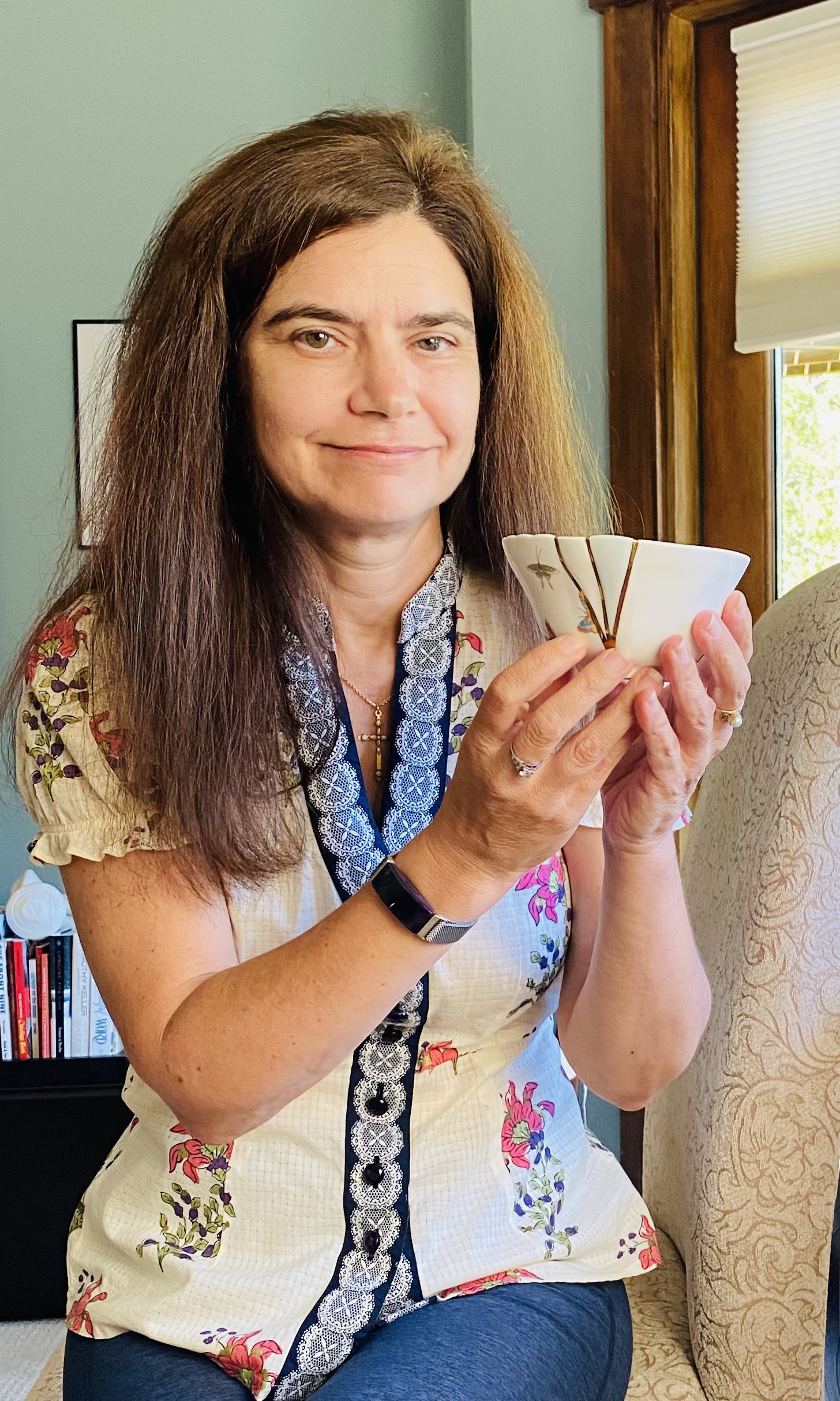
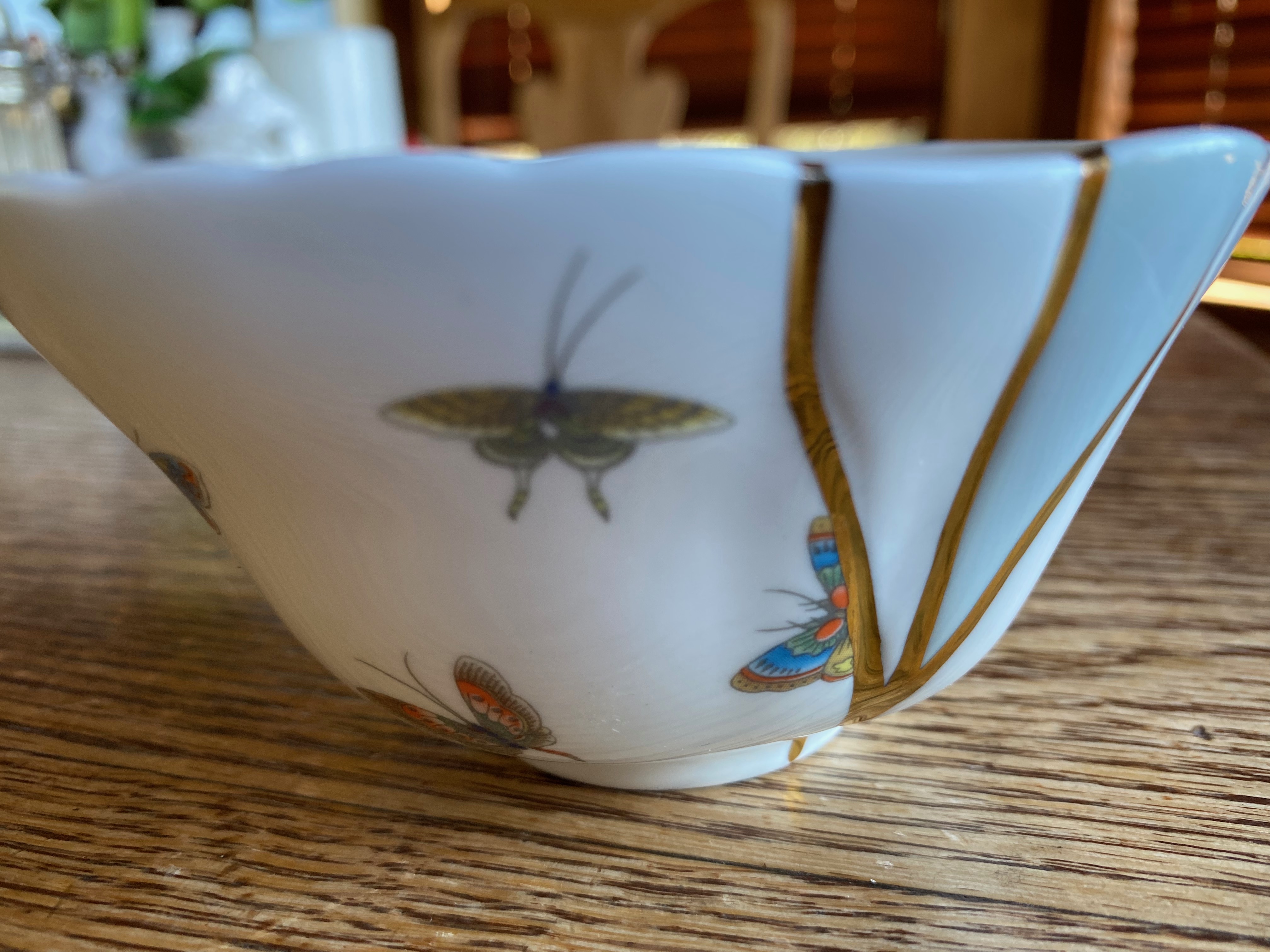
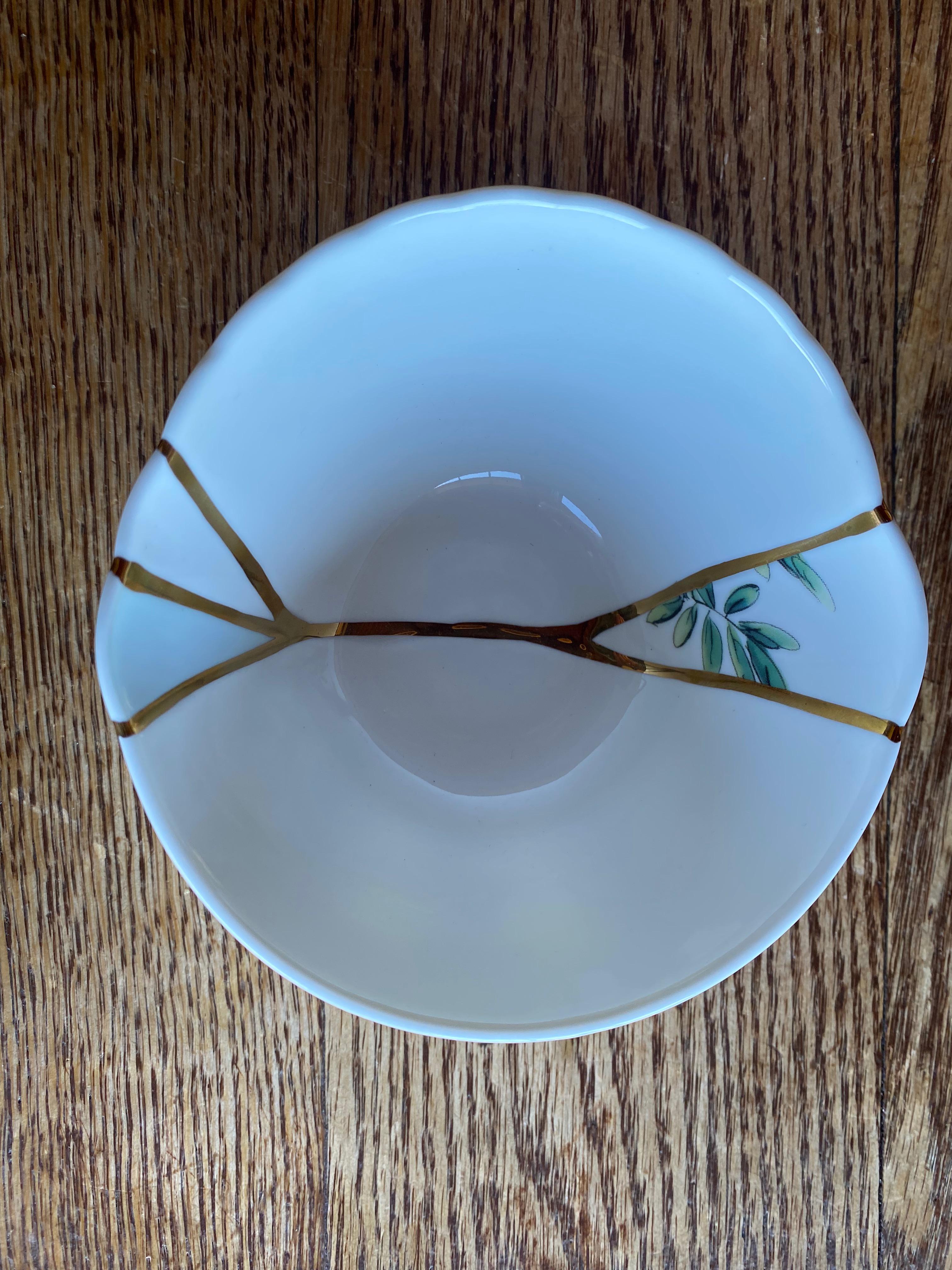
In the midst of my struggles, my friend Merrilee gave me a kintsugi bowl, pictured below. Kintsugi is a Japanese art form wherein broken pieces of pottery are repaired using gold filigree to fill in the cracks. The object then becomes even more beautiful as a result of the repair work.

“I’m gifting you with this kintsugi bowl as a daily reminder that God heals the brokenhearted,” Merrilee wrote. She quoted Isaiah 42:3: “A bruised reed he will not break, and a smoldering wick he will not snuff out. In faithfulness he will bring forth justice.”

Merrilee encouraged me that I would be healed, that I would be useful and beautiful and that God would use this awful season for His glory and as a way to give me a greater purpose. Merrilee is a kindred spirit in this regard. She has also gone through a painful divorce these last few years. Her broken heart has helped heal mine.

I promptly put the kintsugi bowl on my dresser, in between photos of my two handsome sons. Then, a funny bit of serendipity happened a few months later. I was browsing in a gift store and happened to come across a wonderful book about the Japanese philosophy of wabi sabi. I had never heard of wabi sabi before, but I learned that it is an ancient way of thinking. Essentially, wabi sabi says that all things are imperfect, unfinished and impermanent. Wabi sabi says we shouldn’t strive for perfection in our lives or work, but rather, live in the moment and accept—even embrace—our imperfection. Wabi sabi thought pervades all of Japanese culture and the arts. Kintsugi is one way to express it.

What a stroke of good timing that I came across this book! (If you want to read more, look for “Wabi Sabi: The Wisdom of Imperfection,” by Nobuo Suzuki.) I read it through twice and bought several copies for friends. The most meaningful sections for me talked about how we can actually be stronger after we have been broken. Like the kintsugi bowl, “our scars are not to be hidden; they are actually part of our story…What we have survived this far is our greatest treasure. A wound is the entrance by which light penetrates you.”

There is so much about wabi sabi I want to embrace. I love how it emphasizes living in the present in place of being “burdened by the past or frightened of the future.” I love how it embraces imperfections and asymmetry, simplicity and nature. You see it everywhere in Japanese art, from haiku poetry to the art of bonsai growing to Zen philosophy to the cherry blossom festivals every year.

At the end of the book, the author gives suggestions on how to live a wabi sabi life, basically encouraging readers to simplify, declutter, live in the present, and keep a journal that notes what did and did not give one energy that day. It’s true that we hear these concepts frequently these days—in fact we almost become numb to this talk. But do we really do them? In fact our Western culture works against these concepts. Its focus on perfection, symmetry and complexity is quite the opposite of wabi sabi thinking.

Do you already practice wabi sabi in your day to day life? I reflected on this question a bit and the first “wabi sabi” thing I noticed about my days was time spent with my dog! When I walk my dog or play with him, I’m completely submerged in the present. I’m not thinking about the past or the future, but just enjoying the way he smells the bushes or laughing at the way he pulls on his rope. Pets are great generators of wabi sabi practice!

Another “wabi sabi moment” for me is walking. There is nothing so healing to me as walking the beautiful shoreline path by my parents’ house and observing the changing tides, pelicans and wildflowers. Those are true wabi sabi moments. There’s nothing to strive for, nothing to perfect—just plain acceptance and recognition of what’s in front of me. Each walk is new and different. As it’s said, you can’t enter the same river twice…each time I walk I notice new details I haven’t seen before.

If there’s one thing this divorce has taught me, it’s that nothing is permanent. I thought I would easily celebrate my 50th wedding anniversary some day. That was not to be. Nothing is perfect, either. I have accepted the fact my marriage had flaws—fatal ones. Wabi sabi, though, says that my story isn’t over. I can be stronger as a result of my cracks. I still have a lot left to give the world.

Wabi sabi is not unlike the Christian concept of grace. God can redeem any situation. He can take the pieces of my broken life, repair them and make something beautiful. In my worst moments I had trouble believing this. I questioned God. I felt abandoned. Now I see I had to pass through those waters to get to where I am now. Life still feels awfully hard sometimes; our divorce is yet to be finalized. But the cracks are being repaired. I am growing stronger and brighter, facing each day one at a time.

Al’s story: from atheism to Jesus

Al’s story: from atheism to Jesus


Al Tizon was my pastor for five years at Berkeley Covenant Church. Al is an intense person, a good storyteller and a man on a mission. It’s hard for me to think of a person as intentional about his life as Al. He told us once that he recited his life mission statement every morning when he woke up. The statement goes something like this: “action and reflection on the world to transform it.”

Before coming to Berkeley, Al and his family had spent 10 years on the mission field in the Philippines, where he was born. (He came to the U.S. at age 2 and grew up all over the country.) In the Philippines Al founded a ministry among people living in a garbage dump. Al practiced “holistic” ministry, something he often speaks passionately about: the need to preach the gospel in Word (the Bible) and deed (practical ways of serving people’s needs). Word and deed were Al’s mantra. In preaching this, he was seeking to bring balance to the way Christians in the past have emphasized one side over another. The Billy Grahams of the world focused on preaching the Bible. The current crop of Christians promotes social justice. Often these two are seen in conflict, but Al reminded us that both were important.

Al’s zeal took him to bigger places. He left Berkeley Covenant to become a professor of missiology at Palmer Seminary in Pennsylvania and head of Evangelicals for Social Action. Then he took a job as a professor at North Park Seminary and headed the Covenant Church’s world mission arm. Recently he and his wife Janice moved back to California to be closer to their four children and grandchildren and he’s looking for another teaching job.

Al’s own life is a study in transformation itself. His growing up years were chaotic. He pursued drugs and atheism as a teen until a chance meeting at a church changed the trajectory of his life. Every time I hear Al’s story I am amazed. What follows are Al’s own words about his journey to faith.

***

Al’s story

I come from a good Filipino family in that all the kids were baptized in the Catholic church. Unfortunately that was more of a cultural thing and as a family we did not go to church. In fact I can count the number of times on one hand that we as a family went to church and it was usually during crisis. But I remember many crises where that was not the first place we went. It had to be really bad. And it was my mother who would take us to mass. So it just wasn’t part of our family. We were all baptized because that’s what you do as Filipinos. You get baptized in the Catholic church. And there were icons, Catholic icons, around the house. Mom had statues of the Virgin Mary, a crucifix, the Virgin Mary on the dashboard of our car. But religion was not part of our household. You never talked about it.

Mom was a medical doctor and a nanny raised us. We called her Lola, which is translated “grandmother” in the Philippines. She was part of the family and she was a distant relative of my mother’s. We grew up with two mothers. Our biological mother was a doctor full time. She was gone a lot. And Lola was the mother at home who fed us and put us to bed and changed our diapers and each of us loved her in their own way. But there was conflict there too. There was jealousy, especially from my biological mother who wished that she had been home more and took it out on Lola.

Dad, for much of my growing up years, was working for the Philippine government. He was what they called a commercial attaché. And basically it was his job, when Filipino diplomats, Filipino VIPs, came to town, to show them a good time.

There were parties all the time at our house. We thought they were just people, you know, mom and dad’s friends, but they were VIPs from the Philippines. We had governors in our house, entertainers, prominent business people. I didn’t know that. They were just people. And one of the ways that that job impacted the family was that the government transferred Dad every two, three, four years to a different embassy or consulate. So we moved around a lot. I went to five different elementary schools.

We were in L.A. first, then Seattle, then Honolulu, back to Seattle and then New York City. I spent three years of my childhood in New York City, in the Bronx. It was there that he resigned because it was just hard on the family. He resigned and went into real estate. We were long enough in the country that we were all given permanent visas and eventually became citizens. I was 14 when I became an American citizen.

Now around the New York days, once my dad resigned, we moved back to the Pacific Northwest and into a little town in eastern Oregon called Umatilla. So we went from the Bronx, New York to a little dinky town in eastern Oregon that had less people than the apartment building that was right next to us. Talk about culture shock. One of the biggest cities in the world to a town of 750 people. And we moved there because my mother was offered a job at the Umatilla County Hospital where she served as one of two doctors in the entire county.

It was during that time that it was discovered that dad had another family. It was hard on everybody but of course hard on Mom and in fact one of the reasons that the move happened from New York to Umatilla was that Dad broke it off with the other woman or tried to. And we moved across country while she followed. My mom and dad really tried to make it work but it just too late. There was just too much damage done. And they finally did get a divorce. My dad ended up going back to Carol.

Their affair actually started in Seattle. And then it continued. We moved to Hawaii. She moved there. Nobody knew. She had a family too. She left her family and followed Dad around. But she also started a family with my dad. It’s the stuff of soap opera, drama. And there’s more to it. I mean Carol—all’s forgiven—she’s Aunt Carol now. But she was one of my mother’s best friends and the cover-up was such that my oldest half sister, when she was baptized, my mother was asked to be a godmother to her, not knowing that she was Dad’s daughter. It was just really hurtful. Other lesser families I suppose, you know—it would have ended much worse than it did. It was bad. I mean Mom was not in good shape. None of us were.

But what happened was that when we moved to Oregon and Mom and Dad decided they just couldn’t do it anymore Dad went back to Carol and mom got a new boyfriend named Ivan, completely the opposite of my dad, I mean totally unsophisticated—Dad was a sophisticated suit and tie guy. Ivan was a barber who Mom basically controlled. She couldn’t control Dad but she could control this guy. But you know this poor guy comes into a family of four teenagers whose family just blew up. I mean it’s already hard enough to be a teenager. So within a year of their divorce they both got remarried and suddenly we had step-siblings. This was Ivan’s fourth marriage. And it was just chaotic. So we all reacted differently. I went the way of drugs and partying. I was 14. And it was really funny because growing up, we didn’t go to church. But I look back now and I had religious sensibilities. I didn’t know where they came from but for some reason I felt the need—I don’t know where it came from—but I memorized the Lord’s prayer and prayed it every night. I watched Davey and Goliath religiously at 7:30 every Sunday morning. It was a claymation about a boy and his dog that talks to him about matters of faith and morality and ethics. It provided a kind of perspective, a kind of alternate narrative of family that I didn’t have at all. There was a mom and dad of Davey, his sister, and Goliath the dog. I don’t know for some reason it had real impact on me as a kid. But at 14 when the family blew up I blew all that off and I just said religion is just nothing—it’s not true, God can’t be real. And so as a self-proclaimed atheist at 14 I really lived like it—the whole drug culture thing. I only have one speed for life and that is just you just go for it. I mean I pursued drugs like I pursued anything. I did it every day, I got to a point where I was selling it. I mean I was dealing, marijuana and illegal black market drugs like quaaludes. We would also harvest psilocybin mushrooms. There was a group of us that was cultivating mushrooms and selling them and eating them.

I was 14 ,15, 16 and I was very, very deeply immersed in the drug culture. But it wasn’t at the expense of other things too. I was doing drugs but my stepdad knew this. He was street savvy. He knew that I was into it. My mom wouldn’t believe him because I came home with straight As. I was in sports. I was in with the jocks too. I played football and basketball and track. All the while I’m just doing drugs everyday. I was really popular. From the outside you know, like from my mom’s perspective and a lot of people’s perspective, I had my act together. But I was really hurting inside.

At age 17 a former girlfriend named Jane came to faith and I couldn’t believe it because among other things that we did together we shared our journals. There weren’t a whole lot of high schoolers that even wrote in journals, but we did. We were just trying to be self-aware. And we would share entries on a fairly regular basis. And one thing we shared was just this angst, you know about life and is it worth it and all that. So one day she shares a journal entry with me that described her conversion. I thought she was joking. I thought, no way. I mean Jane, come on—you and I, we’ve been fighting this whole theism thing and now you’re telling me that all this is real? When I was convinced that she wasn’t joking I got really, really mad at her. I couldn’t believe it. She sold out? And so in my own way I stormed out of her life, but I was also just sort of watching her. And I just saw a transformation in her. She just had this brightness in her eyes. She wasn’t doing drugs anymore—she wasn’t sure about the parties. She was instead hanging out with this group of Christians who met every Wednesday night at this youth rally called Son City and she’d invite me on a regular basis to go check it out. She said Al, I know you don’t believe in God but check it out. And one day I was stoned enough to say yes to her and went with her. I heard the gospel for the first time. I heard a version of the gospel that was clear to this desperate teenager. It just sounded like very good news. And I was desperately wanting it to be true. I still remember the three points of that sermon. That was 37 years ago: God is real, God can be known, God loves you.

I went back years later, I’m talking like 20 years. I talked with the preacher at the time, a Bible school intern named Ralph Roland. I said hey, you know, thanks for that sermon. He ended up being a pastor up in Seattle and he honestly couldn’t remember the sermon. He said, I’ve never preached that sermon before. I know he did. I mean it was one of those things. So God used that night to speak good news to me. This was run by a Baptist church. So there was an altar call and I went up and repeated the sinners prayer and all that and stayed for a couple hours and asked a bunch of questions.

But then I went home and I only have one speed. I said, OK, if this is true then I’ve got to change. I’ve got to abandon my former life. I took my thousands of dollars worth of paraphernalia. I flushed a lot of it down the toilet. It was an act of baptism almost, it was as an act of commitment and that was it. I never looked back. The funny thing is the first month, month and a half or so I didn’t tell anybody. I didn’t tell my cool friends because I was popular, I was at the parties and I didn’t tell any of them. If they asked me why I wasn’t going to parties I said I was tired, I’ve got to do this, I’ve got to do that. I never told them it was because I became a Christian. It was real, but I was still kind of embarrassed, especially because I was very vocal about no God and all that. So it wasn’t until another experience that my Pentecostal friends later told me was called the baptism of the Holy Spirit that I became not just not ashamed of the gospel but a bold proclaimer of it.

I was reading the book of Revelation. It was actually the first book that I read in the New Testament. It made sense to me for some strange reason. I was a sci fi reader, still am. But it made sense, at least I thought it made sense, enough to turn the page. I wasn’t getting lost. I understood what was happening. And I don’t remember where in Revelation. But I remember reading it and getting an overwhelming sense of assurance that what I had decided in Christ was real and that all that you’re reading is true. I mean the only way I can describe it is this overwhelming wave of confirmation that resulted in me just laughing, and the physical manifestation of goose bumps. There was a physical manifestation. It was from that point on that I went to the parties with my Bible and I was telling people about Jesus. It was the craziest thing. That was the beginning of my mission, my evangelism.

I was a junior in high school, a late junior. I just never looked back. It just grew from there. I read my Bible voraciously. Not having grown up in the church, it was so new to me. I didn’t know what to look for. I didn’t know what the Bible was. It just tasted good as I was reading through the New Testament. I just kept learning. Church helped.

My church journey is strange because in obedience to the disciplers—my early disciplers—the leaders of Son City, I did attend the church that Son City was attached to, it was called Salem Heights Baptist Church. But I just couldn’t do it. It was just too weird for me. It was just too strange and too underwhelming. I just gave my life to Jesus and I was passionate and excited and intense about it and I’d come to church and the service did not correspond. The music didn’t correspond with what was going on. So I didn’t do that for very long. I ended up going to the only place I knew, which was the Catholic church. So after two or three attempts at Salem Heights Baptist I went back to the Catholic church but that was garbled too. I didn’t get it. I don’t know if it was worse but it was at least familiar to the extent that whenever we went to church as a kid, that’s what it looked like and felt like.

I saw Janice one time at church. She was dating a Catholic at the time. She was really surprised to see me there. She knew me as a drug dealer, an atheist drug dealer. I had known Janice in high school. Her house was kind of a hangout for druggies because her older sister was also part of the drug culture and her mom recently passed away and their dad was away a lot—he worked in in Portland; they lived in Salem. He often stayed there in Portland and came home on the weekends. So the house became a kind of hang out. That’s where I met Janice. She was a new Christian, having come to faith through Young Life, and her sister Nancy would tease her about it. That didn’t seem to faze Janice. She didn’t stay away from us and judge us. She was just always with us. She was part of this group. She didn’t do anything. And we kind of gave her a bad time about that—come on Janice, try this. But she was just, nah, that’s OK.

She had come to Christ about three years before this. But at that time it was a fresh experience for her. And I was just entering into deep immersion into the drug culture. I mean I was doing drugs off and on since I was 11 and then at 14 it was every day. It was deep. It was during that time that I met Janice. And it was during that time that Janice gave me a disguised Bible called “The Way.” I didn’t know what it was but it was nice of her. And so when I came to faith three years later—and in the middle of just reading this thing that she gave me three years before—I saw her at church at St. Joe’s and I said, “Hey Janice, thank you for the Bible. I’m reading it now.” She was just shocked at the transformation that was going on in my life. And she hardly even remembered that she bought me a Bible. From that point on we began to talk to each other pretty regularly over the phone and we’d see each other.

Janice is one year older. She’s the class of ‘79. I’m the class of ‘80. She wasn’t really satisfied with the church she was going to. I didn’t even know there were other kinds of churches. So she told me about a place in town called Christian Center Salem. We decided to go. And it was there that I met people who were as excited as I was about the faith. And Janice too. She’s a PK (a pastor’s kid), but at Young Life things really came together for her and she was really excited about her faith. So here’s this PK and this ex drug dealer really excited about the faith and we started going to Christian Center. Christian Center turned out to be an Assemblies of God Church. People there are happy, they’re jumping around and singing. And that really resonated with me. So we stayed. We were there for years until we moved from Salem down to Southern California. But we ran with the Pentecostals for a long, long time. And in fact we ran with the Pentecostals until we moved to Berkeley. My first ordination was with the Assemblies of God. And then it was with Calvary Chapel and then when I took on Berkeley Covenant I started my journey to the Covenant Church.

I would say that where I have to apply the most discipline today is to keep my spirituality as the motivator for my mission. It’s so easy to not maintain my relationship with God. And I would even say that it’s an occupational hazard because you can convince yourself that, hey, I’m doing God’s work. I might as well just do it. But I do have disciplines that I maintain and there is nothing earth shattering about them. You pray. You study the scriptures, you fellowship and you bear witness. Those are my four, my attempts at daily disciplines. It’s my pushups and sit-ups. I need to be in contact, communicate with God. That’s through prayer and through study of scripture. But fellowship is also important daily. And I find that very useful. I can have a conversation with my wife and say hey, I’m fellowshipping with a sister in Christ. We’re fellowshipping in this case. But it’s to remind me that I’m not alone and that ministry is not a lone ranger kind of endeavor. It’s community. So that’s the importance of the discipline of fellowship. Also bearing witness, which to me is a discipline, is important, especially for ministers who can spend their entire days, each and every day, with Christians. So who are you bearing witness to? To me it’s a discipline to be intentional about maintaining a sphere of non-Christians in my life. So my introverted self reaches out to neighbors who don’t go to church. We have relationship. It’s being constantly aware of merchants as I go into stores. And you know bearing witness is holistic. It could be in word. It could be in deed. It could be both. It could be writing a letter to my congressperson. It could be having a God talk conversation with a neighbor. But I try to be aware that it’s a daily thing. Every day I need to be bearing witness to the goodness of the good news. Now ask me how well I do? The disciplines keep me healthy and keep my spirituality intact. And I know that if I’m doing those disciplines then the mission that I’m in charge of will be fueled by that. It’s tough, it’s really, really tough. So I would consider that the greatest challenge, is to commune with God in order to be the most effective holistic minister and that’s a personal thing. I see great challenges out there—violence and wars and all things that I’m encountering as I go around the world. But in terms of my journey that remains the challenge that’s ever before me.

If I could look back to my 17-year-old self starting my journey again I would say, why did you start so late? I mean God has used the pain of my family and that’s God. God takes broken things and makes beautiful, useful things out of them. But so much of the experiences of brokenness and the way I responded didn’t have to be. Yes, God has used my brokenness to make me who I am. But I’ll tell you there were times during that period where suicide was a viable option. And I’m not talking about desperation. I’m talking about well thought-out plans to not live a life, this is not worth living. I remember sitting around with my best friend Gary at our little treehouse where we stashed everything. We had this very calm conversation. We had quaaludes right there. You know, we said, life’s hard. We don’t know why we have to go through it when there’s no real purpose for it, no real meaning for it. Why do it? You know we could just take that bottle right now and be done with it. If we had more courage we would have done it. But we were chicken. The point is that, wow, if I could talk to that person now, I would say that’s not an option. There’s so much to live for. And when you’re in touch with the one who made it all and you’re on a trajectory toward the kind of life that God would have for us, it’s an amazing beautiful thing. It is worth living for. I guess I’m talking to my pre-Christian self.

I really do feel like I’m still as excited today about my faith in Christ as I was when I said yes. I really believe that. Sure, there’s ebbs and flows and deserts and all those kinds of things. But the long haul 37 years later, I just would not have it any other way.
Reflections on St. Patrick, thin places and the story of Hagar

Reflections on St. Patrick, thin places and the story of Hagar


I’ve never really celebrated St. Patrick’s Day or thought it was very significant. I thought wearing green was kind of silly. Maybe it’s because I don’t have any Irish blood. But recently I’ve been listening to some podcasts put out by InterVarsity Christian Fellowship and they focus on Celtic Christianity, with stories about St. Patrick. His story is more interesting than I imagined.

St. Patrick was only 16 when he was captured by the Irish in his home in Britain and taken to Ireland. He lived for six years as a slave there, tending to animals. He prayed and converted to Christianity during his captivity. Eventually, he was able to escape on a boat back to Britain and his family, where he continued to explore Christianity and became a pastor. After some years of study, he had a vision of a man from Ireland asking him to come back and walk among his people. So Patrick returned to Ireland and became a missionary there, baptizing many people.

It can’t have been easy for Patrick to go back to the place where he was held captive as a slave. But he obeyed God and saw much fruit. He is the patron saint of Ireland and legends of his work abound. One legend says that Patrick used the three-leaf shamrock as a way to teach the concept of the trinity. Another legend says he cast out all snakes from Ireland, but it seems this is more legend than fact.

I’ve never been to Ireland, but I’ve been to Scotland and it’s one of the most beautiful places I’ve seen. The hills are lush and green. I had one of my first encounters with God while traveling there. My family was staying at an old lodge with an English family and during the day we would go fishing. One day I decided to take a walk on my own in the hills. I was only 11 but I sensed God was near. The beauty of the place convinced me God was real and he loved me very much. It was only a momentary experience but it has stayed with me all these years. They say Ireland is a “thin” place where you can sense God more easily. For me Scotland was a thin place too.

Patrick was brave to return to Ireland. In my own life I can only compare this to a time when my husband and I were asked to live near his aging father. Peter’s father lived in the same house where Peter had grown up and he was slowing down. There was a small cottage next to the house and the renters had just moved out. Peter’s family thought Peter and I, who did not have kids yet, should move into the cottage and look after his father, Ned. It wasn’t an easy decision. Peter and I were in our late ‘20s, seeking a more adventurous lifestyle. We had just returned from a seven-month trip to Europe and our dream was to live in San Francisco and experience city life. Moving back to his family home in a quiet suburb seemed like a step in the wrong direction.

We prayed about this decision for several weeks and finally decided it would be good for us to move into the cottage. We set our dreams aside. But it turned out to be a great decision. We were able to spend many nice evenings with Ned, watching Jeopardy and Wheel of Fortune or a Giants game. He appreciated our company. We set up a baby monitor in his bedroom so he could call on us at night if needed. I still remember hearing his heavy breathing on the baby monitor.

About a year into our stay there Ned, who was 82, had to have an emergency appendectomy. He never really recovered. He slowly went downhill and the last month of his life he spent in a hospital bed in his living room, with his beloved fireplace going 24/7. We sat by his side and rubbed his wrists, which he liked as they were always sore. He passed away on Valentine’s Day, just as the cherry blossoms were in full bloom. He had lived a full, good life and we had the privilege of spending his last year and a half with him.

I can confidently say that God directed us to move next door to Ned. These days I find myself in a similar, yet different position. I have moved back to my parents’ house as I’m in the midst of a divorce. It is a hard time yet a unique time as I live again with my parents after so many years apart, and we each enjoy one another’s company. I don’t know how much longer I’ll have my parents with me so I treasure each day.

**

The Celtic Christianity podcast contained not just stories about St. Patrick, but Bible stories too. One I connected with was the story of Hagar. Hagar was Abraham’s wife’s maid-servant. When Abraham’s wife, Sarah, could not get pregnant, she suggested Abraham sleep with Hagar. So Abraham did and Hagar bore a child, Ishmael. But Sarah treated Hagar harshly after this and Hagar ran away. Then, an interesting thing happens. An angel appears to Hagar at a desert spring where she is resting. The podcast says this is the first account of an angel appearing to anyone in the Bible! It is significant because Hagar is a person without power. She is a runaway slave, a woman, and homeless. Yet the angel appears to her and comforts her.

I found great comfort myself in this account of the angel appearing to Hagar. I, too, feel quite powerless in this moment. I am a woman in the midst of a divorce, feeling weak and often depressed. But if an angel could appear to Hagar, certainly an angel could appear to me. And angels have appeared, in the form of friends and family who have reached out to me with loving words and encouragement.

**

Some years ago I came across a prayer attributed to St. Patrick. It is simple, yet powerful. I’ll end this post with the most famous section:

Christ with me, Christ before me, Christ behind me,
Christ in me, Christ beneath me, Christ above me,
Christ on my right, Christ on my left,
Christ when I lie down, Christ when I sit down,
Christ in the heart of every man who thinks of me,
Christ in the mouth of every man who speaks of me,
Christ in the eye that sees me,
Christ in the ear that hears me.

This St. Patrick’s day I have a deeper appreciation for the man and the God behind this saint.

Leaning into loneliness

Leaning into loneliness


I don’t bother taking all the decorative pillows off the bed anymore before I go to sleep. I leave the ones on Peter’s side intact. Maybe I’m being lazy or maybe it’s that those pillows fill that side of the bed in a way that makes me less lonely. There’s less empty space. In any case, bedtime is painful. I’m reminded that I no longer have my life partner with me. My dog curls up next to me, which is nice, but he can’t talk to me about my day or give me a hug. Peter’s been gone a long time now and I’m still not used to it.

I’m at my writing co-working space as I write this. I come here a few times a week to write at a large table along with several other writers. It’s a pleasant place, quiet except for the clicking of keyboards. Nice light filters in from the street and Peet’s coffee is around the corner when I get a hankering for a latte. The other writers here are working on novels or dissertations or even epic poems. I feel a bit embarrassed to admit I’m working on a lowly blog, though I know it has great value in its own way.

Is it healthy to write about my pain, to think about the pillows and painful bedtime? Somehow it feels right. I don’t want to hide my pain or run away from it. I want to face it and learn from it. Only by facing it can I heal. And for me facing it means writing about it.

The greatest pain I experience in my separation from Peter is loneliness. I’m lonely when I go to bed at night. I’m lonely when I wake up. I battle loneliness and anxiety throughout the day. The timing of our separation couldn’t be worse. Not only is Peter gone, but my sons as well. For the first time all of us are living in different cities. This is not the empty nest life I had pictured. I’m sure it’s not what Peter had pictured either. Peter is lonely too. He was the one who left, but I know it’s not easy for him either.

Although I’m an introvert and a writer, I’ve never liked being alone for long stretches. In fact, one of the tensions of our marriage was my need for togetherness. Peter wanted more time on his own, to play golf (a minimum of five hours), followed up with beers with the guys, or to go to Giants games for the full duration, from watching pregame warmup practices to post-game beers in the Gotham club. I disliked being alone for such long stretches and although I gave him my blessing to do those things, he knew I wasn’t happy about it.

A million little things remind me of Peter and how his schedule impacted my life. Recently I was talking with someone about their spring break plans and they mentioned that Easter was late this year, April 17th. Immediately I thought, that’s great, this is one of those rare years when Easter falls after the April 15th tax deadline. That means Peter can join us in our Easter celebrations instead of being weighed down by tax returns. Then I remembered, this is no longer. We won’t be celebrating together this year.

I have been spending time with my sweet parents and they have a very loving relationship. When I spend the night with them we have an evening ritual that starts with a glass of wine around 5, followed by dinner. Then we retreat to their bedroom to watch “Jeopardy” at 7, followed by a movie we pick at random. My dad and I sit in chairs facing the TV, while my mom watches from her bed. Even Romeo the dog has his spot in a chair. By 10 it is bedtime and Dad goes over to Mom to give her a kiss and say “I love you.” Suddenly I feel a loss. Where is my partner who wants a kiss and “I love you” too? But I also feel a twinge of regret. How many nights did I forget to tell Peter “I love you” because I was engrossed in a book. Would things be different if I had remembered to do that every night?

After telling my son TJ about my loneliness, he recommended I listen to a podcast with David Whyte on the subject. He had no way of knowing it, but I love the poet David Whyte! I’ve listened to one of his audiobooks several times, just to enjoy his lilting Irish accent.

Whyte has some lovely thoughts on the topic of aloneness. He says aloneness gives us the chance to befriend ourselves, get to know ourselves better. “You have to bring a bit of silence into your life, taking the headphones out of your ears, and starting to pay attention to what’s speaking to you, or what’s about to precipitate out of your life, to what’s coming into season, the invitation to make friends with the stranger who’s just about to walk into your life, the stranger that is you.”

Aloneness can be been seen as a state of exile, Whyte says, but if you can accept it you can see it as a foundation for understanding yourself. It’s also a chance to ask for help from others and a chance to pay attention to the world around you—“the blue in the sky, the red in sunset, the movement in the leaves when a breeze is coming through, the smell of grass, the feel of summer breeze on your skin.’’ Whyte says we’ve forgotten we have a friendship with the natural world.

These are wise words in the abstract, but difficult to embrace. It strikes me that aloneness is different from loneliness. Aloneness can be positive; growth can take place. It can be a peaceful state. Loneliness is just hard and empty and uncomfortable. I want to move from this position of loneliness towards healthy aloneness.

So I start close in. I take the first step. As I finish this post I look around. I’m sitting in a warm corner of my parents’ living room. The afternoon sunlight streams in the window, illuminating the white carpet and sofa. An orangish red amaryllis is blooming in a pot on the coffee table. I think of the swarm of seagulls I saw on a walk down by the shore this morning. The birds were busy eating something in the shallow waters by the rocks. A passerby explained that the herring were spawning and the seagulls were having a feast. For a moment now, I’m glad to be alone with my observations. For this moment, I’m alone, but not lonely. It’s a start.

Just Beyond Yourself

By David Whyte

Just beyond
yourself.

It’s where
you need
to be.

Half a step
into
self-forgetting
and the rest
restored
by what
you’ll meet.

There is a road
always beckoning.

When you see
the two sides
of it
closing together
at that far horizon
and deep in
the foundations
of your own
heart
at exactly
the same
time,
that’s how
you know
it’s the road
you
have
to follow.

That’s how
you know
it’s where
you
have
to go.

That’s how
you know
you have
to go.

That’s
how you know.

Just beyond
yourself,
it’s
where you
need to be.


Crossing the threshold

Crossing the threshold


Today was the day I took off my wedding rings. I hadn’t realized how much I played with them, rolled them around when I was bored, until now. I feel naked without them, exposed. I wonder if anyone will notice they are gone.

I noticed my husband had taken off his ring a couple of weeks ago. I was shocked at the sight. This is real, I thought. He’s really doing this. He really wants to be single. I can’t believe it.

All year I’ve been catching up with where my husband is at regarding the state of our marriage. The first six months he was giving me conditions under which he would come back. I dragged my feet on some of those conditions. When I finally agreed to all of them, he had moved on, and said he wanted a divorce. In reality, I think he had moved on long before that. He just was afraid to use the word divorce.

A divorce—I can barely type the word. I never in a million years thought we would get a divorce. Peter has been the archetype of loyal, supporting me and our family through thick and thin. I can’t explain why he’s doing this now. It feels awful, like I’m living someone else’s life. This can’t be my own life, I think. This must be a bad dream and I’ll wake up from it someday soon.

It’s not easy to live alone after 33 years of marriage. I’ve spent a lot of time with my parents in their home, absorbing their love and support. When I’m at my own home I’m at a loss for what to do. I spend a lot of time pacing, trying to do positive self-talk.

Today our contractor came and installed new front doors. We’ve waited almost a year for these doors. They are beautiful craftsman-style doors that fit the style of the house much better than the old ones. I will paint them red, which seems bold and bright. Perhaps they mark a new chapter in my life, a chapter in which I seek my own path, without Peter.

How do I go through that door to find a new life? I have to tell myself that I am a good person, and that I deserve happiness just like the rest. I wanted to save our marriage–I went to therapy sessions and gave it my best effort. I don’t want this divorce. I want to honor our vows, no matter what. But Peter and I are not on the same page in this. He doesn’t want to save our marriage no matter what. I have to accept his position and move on.

What does God have for me in the next chapter? It’s a question I ask a lot these days. Last night my mom and I watched the movie “The Shack.” It’s about a man whose young daughter is abducted and killed by a stranger. The man, who is devastated, receives a mysterious note to come visit a shack outside of town. When he gets to the shack, three people are there to meet him: an older black woman, a young Asian woman and a young Middle Eastern-looking man. The man soon realizes he has met the trinity. The black woman is God, the Asian woman is the holy spirit and the man is Jesus. They give him comfort and allow him to glimpse his daughter happily playing in the afterlife. For me, the best line of the movie was when God (the older black woman) said she can do amazing things out of horrible situations. I needed to be reminded of that. Even in the worst circumstances, God can bring healing and good. As Jesus said, “All things are possible to him who believes.” God, let me believe.

My writing has been at a standstill these last months. I’ve been hesitant to write about my marriage. Somehow writing makes things more real and I’ve been reluctant to admit this divorce is real. I also don’t want to overshare. Hopefully I’ve found the fine line between being honest and divulging things that are too personal. I still care for Peter intensely and don’t want to misrepresent him. I know he still loves me too.

Despite my writer’s block and my deep sadness, I have seen God provide for me in these last few months. I’ve been in touch with my brother and a dozen friends who have reached out to me for walks and lunch. Being with friends has eased my loneliness. I still feel an ache deep inside my chest but it goes away temporarily when I’m with others and can focus on their lives. The holidays were also a brief respite from the pain, as my sons came home and we tried to celebrate as normal a Christmas as possible, with our usual traditions. My boys have been incredibly supportive of me, with frequent phone calls and texts.

A couple of years ago I led a January retreat that was called Doors and Thresholds and it focused on hearing God’s voice in the new year. To kick things off, the other retreat leaders and I asked the attendees to walk through the neighborhood and take photos of intriguing doors and entryways and then come back and share why a particular door caught their interest. It was a fun activity and everyone came back with a different door. The door that caught my interest was the door to 826 Valencia, a tutoring and writing center created by one of my favorite authors, Dave Eggers. I told the group how much I was looking forward to writing in the new year.

What am I looking forward to this new year? I do hope to get back to writing more often. I look forward to times with friends. I will enjoy seeing my sons continue to grow and develop. I may travel to New York in May for the two-year’s Covid-delayed college graduation of Miguel. I also look forward to shedding some real tears. It’s strange to say, but I’ve been unable to cry this last year. I think I am afraid that I will start and never stop. I actually long to cry, to experience the cathartic expression of grief.

Living without my life partner is very hard. I mourn our passing. It didn’t have to end this way, I think. It could have continued in a positive way. Where did we go wrong? I wish I could have a second chance. But that’s not to be. The sooner I accept this the better. I pray I can move through the door of acceptance.

Empty nest again

Empty nest again


“Let me look up the reviews online,” my son said to me as we walked up and down the aisles of a home goods store looking for bedding.

It’s a common refrain these days as he moves into his first apartment, near his university. It seems there is a review for everything and, being of the online generation, he feels compelled to comparison shop.

I’ve learned a lot about my son during this move. I didn’t realize he was so meticulous in his shopping. He spent two full days just researching mattresses. He spent another day checking out sheets. He compared prices and materials. Later, when we did his first grocery run, it was a very slow process as he compared ketchup brands, yogurts and peanut butter.

Like all milestones in raising a child, moving TJ has been bittersweet. He moved into the dorms in August 2019 his freshman year but had to come home in March due to Covid. Now he’s finally able to move back near school. I had gotten used to him living at home and now he’s away again. Somehow having him move this time is harder. I liked having him around all the time, doing online classes and sharing meals together. We are kindred spirits, both quiet and introverted, so we share a special bond. We get along easily. But I’m glad TJ can resume his life again, and take this step of transitioning to adulthood.

I’ve learned a lot about myself and my mother during this move as well. If it were left to me I might not have gotten involved much in helping TJ shop. He’s an independent adult now. But my mom loves this type of shopping and setting up a house and so we ended up helping quite a bit. Plus, we had a car, whereas TJ didn’t (his university is in San Francisco about an hour from our house). We made several trips to home goods stores and filled our cart with essentials like a desk lamp, a garbage can, kitchen pots, pans and measuring cups.

Surprisingly, TJ has welcomed all our help. He seems genuinely thankful for the shopping help. In contrast, when I was his age I didn’t want help from my parents. I wanted to do everything by myself. So I chose a college halfway across the country and refused to let my parents come to help me move in. TJ, on the other hand, chose a college close to home and is happy to get help. He hasn’t necessarily needed our help but it has made things easier for him.

One big piece of help from my mom was her recommendation to use Nextdoor for furniture. TJ had never used Nextdoor. However, he began perusing it and ended up getting a nice desk and kitchen table listed there. He’s now a big fan. TJ also got a nice sofa, loveseat and TV courtesy of his roommate’s grandparents’ friends. It turns out they were moving and couldn’t take all their furniture. So TJ and his roommate drove down to Salinas, rented a truck and took the furniture (almost new) back to San Francisco.

It’s hard for me to believe that TJ, a college junior, has come so far. I still remember the days in junior high when his room was a mess and his main interest was playing Counterstrike-GO. Somewhere along the line he began to care about organizing his room and clothes. He became more social, hanging out with friends in person. He volunteered at the Humane Society and never missed a shift. It’s been a gift to see him mature in all these ways. Now he’ll start cooking and cleaning for himself, and he’ll need to work out any wrinkles with his wonderful roommate, Enzo.

I’ve now visited TJ a couple of times since he moved in and he’s fastidious about his place. He asks people to take off their shoes and his place is neat and clean. I can’t quite believe it, but it makes me proud. He’s already hung up a few pieces of art and mounted his flat-screen TV. He’s also cooked a few meals, which he didn’t do much at home. (He’s a vegetarian so cooking can be a challenge.) So far he’s made black bean soup and a pasta dish with Beyond sausage, tomatoes and cream, a recipe I made a lot. I think he will survive, and even thrive, in this next stage of his life. I will miss him but am excited to watch the unfolding drama of TJ living on his own.

Bow Ties with Sausage, Tomatoes and Cream

Ingredients

1 12 oz package bow tie pasta
2 T olive oil
1 pound sweet Italian Beyond sausage, crumbled
1/2 t red pepper flakes
1/2 c diced onion
3 cloves garlic, minced
1 28-oz can Italian-style plum tomatoes, coarsely chopped
1 1/2 c heavy cream
1/2 t salt
3 T minced parsley

Directions

  1. Bring a large pot of lightly salted water to a boil. Cook pasta in boiling water for 8 to 10 minutes, or until al dente; drain.
  2. Heat oil in a large, deep skillet over medium heat. Cook sausage and pepper flakes until sausage is evenly brown. Stir in onion and garlic, and cool until onion is tender. Stir in tomatoes, cream and salt. Simmer until mixture thickens, 8 to 10 minutes.
  3. Stir cooked pasta into sauce, and then heat through. Sprinkle with parsley.

Return to Tiburon, pt. 2

Return to Tiburon, pt. 2


As I wrote a few blogs back, I am spending a fair amount of time in Tiburon these days, enjoying the company of my parents and the serenity of my childhood home. Being back here rekindles many childhood memories and the connection I had with this hillside on Mt. Tiburon. I spent hours playing on our hill and down by our creek. This was my world as a child and I’m thankful to have grown up so close to a big city yet surrounded by natural beauty.

The creek in particular conjured up a whole life in my imagination. I pretended I was living out there in a little log cabin (we had a little wooden playhouse) and I needed to fish to get my food. It was my own version of “Little House on the Prairie,” a show I loved. I would get a big stick and pretend to fish, then I’d put my fish on a “fire” and cook them. Every kid should have a creek running in their backyard.

Farther up the creek our neighbor kept a goat named Apples, who, of course, loved apples. My brother and I often fed him an apple. When he died we took over his little hutch and made it our clubhouse. We hung up a free poster we had gotten of some heavy metal band and thus, claimed the hutch. Not that we ever played there much. The hutch was dirty with dried goat droppings.

I’ll never forget the day I found a dead deer on the hillside above the creek. I had never seen a dead animal before and it gave me the creeps. I don’t remember what happened next (did Animal Services take him away?) but afterwards I was always a little nervous entering that part of the hillside. In any case, my brother and I saw lots of live deer. We even knew where the deer slept at night. Below our property there was a natural “cave” formed by the oak trees and bushes. We stumbled upon it one day and saw a few deer in the cave. They seemed mysterious in the dark of the cave. It almost felt like we were interrupting them in their hide-away.

I had my first experience of God on our hillside. I was maybe 11 years old. I remember for a few brief seconds feeling connected to something bigger than myself. I had a vague idea that it was God. I always treasured that experience and can count on one hand the number of times I’ve felt that way.

On a lighter note, my brother and I loved to go cardboard sliding down the hill. We’d take old boxes, flatten them out and zoom down over the dry grass. All the Tiburon kids tried this at least once.

For a number of years my brother and I walked to school by crossing the creek and following a trail downhill. It felt like an adventure. Sadly, a house now blocks part of the path and the trail is totally overgrown. How many kids these days walk to school anyway? We also rode bikes sometimes, down the hill, and a few miles along the path. I felt quite a sense of freedom on my bike, getting around town by myself.

We had go-carts as well as bikes. My dad made them out of plywood. They were simple: plywood, wheels and a rope tied to the front axel for steering—no brakes. Our street sloped so we would drag the go-carts up the street, ride them down the street, then up our neighbor’s steep driveway. That was our natural brake. It’s crazy we didn’t get hurt. I’m pretty sure we didn’t wear helmets back then.

Later on in junior high, we got a dog named Laser. He was a large black dog, part retriever. We bought him outside the Safeway downtown. He loved to retrieve and we would spend hours throwing the ball to him down the hill. Only after a very long time would he get tired. He hated to show this though and usually hid in the bushes when he wanted a break. He also loved the bay and somehow he figured out how to get there from our house, a couple of miles away. We didn’t have a fence around our property, so he could go where he wanted, and many times he would be gone for several hours only to come back matted from swimming.

At the time we got Laser, we had an older little gray terrier named Mary Poppins. Laser breathed new life into Poppins and she accompanied him on his jaunts to town. Sometimes we’d get a call from a local shopowner: “We have a small gray dog and we saw a large black dog with her but we couldn’t catch him.” One favorite place for Laser was the back of the Safeway. There he found day-old baguettes and more than once brought one back and laid it on the front stoop. A gift. Laser is the only dog I’ve known to smile. His mouth formed a perfect smile and his long tongue hung out.

My brother and I were connected to the bay also, as we owned a little 12-foot Laser sailboat (hence the dog’s name). At first we stored the Laser on the Belvedere lagoon and learned to sail in those protected waters. Later, when John and I became junior sailors at the yacht club, we moved the boat there and sailed in the bay. A few times we sailed as far as Angel Island and back. Even more adventurous was riding the ferry waves. After a ferry passed us, John would intentionally steer into the boat’s wake and we’d get quite a ride. John was fearless. Once he actually saved a man who had fallen off his boat. He rescued the man, who was hallucinating from the frigid waters, and towed his boat back to the dock. A local TV news station found out about the rescue and awarded our family a trip to Disneyworld.

Perhaps the best part of living on that hillside in Tiburon was the view. Even as a young kid I appreciated the view of San Francisco and the Headlands. Every night the fog rolled in, creating quite a show. It was different every night. Sometimes just the tops of the buildings were visible. Sometimes it was totally clear and the glass buildings glinted in the sun, like shiny jewels. At night the fog horns blared. Once, when I was in college and living in another city, I fell asleep studying and swore I heard foghorns in the night. I guess I was dreaming of home and my rich childhood memories.

In rough times, God cares

In rough times, God cares


It struck me today how little control we have over our lives. I was traveling on I-580, in the fast lane, just after the Richmond Bridge, going about 65 mph. Suddenly I came upon a stopped truck in my lane, with flashing lights and a sign that said “lane closed.” In seconds I had to change lanes, right in between two larger trucks, a car carrier and an 18-wheeler. Had these trucks been closer together, without a gap between them, I would have crashed. I was shaken up at my close call. Maybe, I thought, God had protected me in that moment. How else could I explain it?

God seems active in many parts of my life. I became a spiritual director in 2019 and I’m happy to provide spiritual care for several individuals. They are deeply spiritual people, very in tune with God’s nudgings. I feel inspired by them each time we meet. I’m grateful that these people found their way to me and I have the privilege to sit with them and offer them a listening ear as they pursue a relationship with God. I do believe God placed us together for a reason.

I need to remember God’s care more than ever these days, as I am undergoing a dark period in my life. My husband moved out of the house in January and is working on his “issues.” I am lonely and sad. I have tried to fill my days with walks and coffee with friends but it’s impossible to fill every minute. Many times I find myself just watching the clock, until I can find relief with another friend. I turn to God in these empty moments; sometimes I hear his voice reassuring me, sometimes not. But I trust that he’s there, protecting me from even worse feelings.

A bright spot in my life are my two sons, now 20 and 23. I am happy to see them enjoying life and developing into adults, post-Covid. Miguel, 23, graduated from college right before Covid and has become a gourmet cook. He sends me photos of some of his meals, like the fresh fish tacos and slaw he made the other night. He has a new job, managing two farm-to-market food stands in Brooklyn. The stands are run by a non-profit that seeks to bring fresh fruit and vegetables from local farms to the city. Miguel is in charge of setting up the stands, overseeing the high school employees that work as cashiers, and breaking them down in the evening. The job seems like a good match for his skills and interests. It’s only part-time, allowing him time for freelance gigs as a photographer and filmmaker.

TJ, my younger son, is at home for just one more week. He was forced to return home from the dorms when Covid hit and now he can finally go back to in-person classes, this time living in an apartment with his dorm roommate. They are excited to move into their first apartment.

Meanwhile, at the end of June, TJ and some friends traveled to Austin, Texas for a ten-day-long stay. They visited their online friends Haydon and Gregg. They did a lot of swimming and a few things I’m glad I didn’t know about beforehand, like cliffdiving. TJ showed me a video of himself jumping off an incredibly high cliff. He got the wind knocked out of him upon hitting the water. Thankfully, he says he won’t do it again. On a lighter note, Gregg took TJ down to Corpus Christi where he lives and they drove along the beach there in Gregg’s jeep, almost to the border of Mexico. On the way they spotted an injured bird and tried to take it to a bird rescue facility (Gregg’s girlfriend works there), but the bird didn’t make it.

As I think about Miguel’s job or TJ’s friendship with his online friends, I can’t help but think God brought these things together. In New York, the city is slowly coming to life again and it was amazing Miguel found a job doing something he’s passionate about. Likewise, TJ has been fortunate to remain friends with Gregg for over 10 years, and with Haydon for about five years.

My kids not only provide bright spots but they bolster my faith that God cares. I may be undergoing a huge trial, coping day to day without Peter, but God still cares for me and has good things for me. I took a walk this morning with one friend and the sun was warm and hopeful. The fog lifted early today. We ended our walk with refreshing ice lattes. Last night I invited another friend over for dinner and I taught her to play my favorite card game, Spite and Malice. It’s a bit of a complicated game but she caught on quickly. So, I tell myself, God provides some pools of relief in the midst of struggle.

Yesterday TJ received a package in the mail from Gregg. It contained a server and a Bonsai Lego set. It was an expression of Gregg’s deep friendship, very sweet. TJ immediately went to work piecing together the server, which will host their game of Minecraft. A couple of weeks ago TJ made his first phone calls about his apartment. I overheard him using his most polite voice to set up an appointment to view a place. I felt proud. He found a place not long after and it’s close to school.

Maybe I’m just being naïve, trusting in God so much. That could be, but when I look at things in a deep way, I just feel there aren’t coincidences. God does listen to our prayers. In fact, I feel convicted to pray more as I write this. I haven’t prayed enough to ask God to lift my darkness. I haven’t prayed enough for Peter and his well-being. I need to pray more. I commit to pray more. If God is in the big things in life, surely he is in the small things too. I need him in big and small ways.