The Joy of Cooking

The Joy of Cooking


I was a reluctant cook in my mother’s kitchen. Why should I learn to cook? My mom did a fine job. She turned out three square meals a day, with dinner set aside as a special time. The four of us, my mom, dad, brother and I, always ate dinner together. The TV was turned off. I set the table. Homework was put away. And we recounted our days over delicious meat-and-potatoes meals—pot roast, pork chops, meatloaf, sloppy joes. Usually mom had a dessert too—a homemade pie or, my favorite, butterscotch pudding from a box. The closest I got to regular cooking was occasionally helping Mom peel carrots or clean strawberries. I remember standing at the sink, peeler in hand, feeling, even then, that cooking could be satisfying. There was something rewarding about taking a carrot and—swoosh—peeling off the rough outer layer to create a smooth surface. The repetitious action of each pass over the carrot filled up the sink with curly orange strips and my mind would wander. But then I’d finish and I’d be off again, more interested in playing with my dog or shooting hoops with my little brother.

No doubt women’s lib explained in part why I didn’t embrace cooking. Growing up in the 70s I absorbed the messages from TV shows and popular culture that women didn’t need to slave away in the kitchen. They could have careers and full lives away from the home. My favorite show, The Brady Bunch, featured a mom who didn’t seem to cook much. The family had a housekeeper, Alice, who seemed to do most of the cooking. I’m not sure what Carol Brady did with her time, but it wasn’t cooking.

There was one exception to my cooking aversion and that was “special” foods. I got excited each February when my grandmother came to visit from South Dakota. Grandma made the best donuts and we bought all the ingredients before she arrived. The day she came we wouldn’t even let her put her suitcase away before coming to the kitchen and making donuts. My brother, Mom, Grandma and I worked on various stations. One would roll out the dough and use a special donut cutter to form the donut shapes. Another one of us would drop the cut-out dough into hot oil and gently turn the cooking donuts as they sizzled away. (It’s a wonder that none of us got seriously burned.) When the donuts had finished cooking they were placed on a paper towel to absorb the grease and one of us would dip the donuts in sugar before putting them in a huge Tupperware container. We ate as we worked and felt a bit sick by the end. But it was one of my favorite days of the year.

Another “special” food we made was blackberry jam. Each August Mom would monitor the blackberry bushes growing wild along the town bike path. When the berries had turned from red to black it was time to pick. We would head out to the path with a stepladder, bags and a few of Dad’s old dress shirts to protect us from the thorns. Picking those berries felt like mining for gold. We dropped the berries in our bags and some were so soft they oozed juice down our sleeves. We came home with our bags bulging and Mom’s equipment for cooking and jarring the berries all laid out. Like the donuts, we had our stations. For months afterwards we enjoyed blackberry jam on toast and blackberry jam on ice cream. I felt proud to have been on the “team.” I’m thankful Mom kept those traditions alive.

As it turns out, you can’t survive on donuts and jam alone. My husband and I got married young and neither of us had done much cooking. We ate poorly the first few years—lots of frozen pizzas, ramen and hot dogs. It took me time to finally learn to cook. We were both working and going to school, and I could see that my husband wasn’t interested in cooking. If I wanted to eat well, it would be up to me. Somehow my old women’s lib beliefs just evaporated. In fact, they not only evaporated but I felt drawn to cooking. On my breaks at work I would read recipes in the newspaper.

I still remember a few cooking mishaps in those early years. There was the time I invited an old friend and her husband to our house for dinner. I decided to make one of my mom’s favorite hors’doevres—a strip of white bread dabbed with cream of mushroom soup and then rolled up, with a piece of bacon around it. I’m still not sure what I did wrong, but the top of the bread burned and the dripping bacon fat smoked up the oven so that when I opened it, the whole room filled with smoke. Since the kitchen and living room were the same room, we couldn’t get away from the smoke. I decided never to make that recipe again.

Another time early in our marriage my husband and I invited my parents to come over for dinner. I decided to make chicken lasagna. I had never made lasagna before. I had no idea that it took so long. My mom was a skilled entertainer and always seemed to have things under control when guests came. She was able to finish her cooking and also engage with her guests. With the lasagna I was stuck in the kitchen, a tiny room not connected to the main room in our small cottage. I felt like a failure, spending what seemed like hours trying to finish the lasagna. I learned never to try a new recipe on guests—and subsequently when I’ve invited guests for lasagna (which I premake), all turns out successfully.

In the ensuing years, while raising two now-grown sons, I’ve become a much better cook. I have my standard rotation, which includes recipes for food I didn’t know about growing up—like red lentil ragout with roasted carrots, shakshuka, and chickpea curry with coconut and turmeric. Plus, I have some special dishes like paella. As it turns out I get a lot of satisfaction out of cooking and I also enjoy the sense of calm it often creates, the same calm I once sensed as a girl peeling carrots. Each time I try a new recipe and the family likes it, I am encouraged and believe just a little bit more, that I know how to cook. And yes, I still make donuts with my mom and whoever else is around once a year and it is magical.


My struggle

My struggle


I roll over in bed and glance at the clock: 9 am. Good, I think, I don’t have to get up for a while. I shut my eyes and fall back asleep. I awake a little later, daring to look at the clock again: 9:30 am. I repeat the pattern again. Fall asleep. Wake up. Now it’s 10 and I force myself to sit up. As with other days recently, I dread waking up. But I’ve told myself I can’t sleep past 10. I’ve been experiencing depression and I wish I could stay in bed all day.

I’m no stranger to depression. In the last few years I’ve wrestled with periods of mild depression that generally last several months. I have low energy and find simple tasks difficult, like shopping and laundry. These depressed periods alternate with gentle up times. During the up times I’m productive, creative and energetic.

It took me a while to see this emerging pattern. A couple of years ago I began keeping “morning pages,” journaling my thoughts and experiences for an hour or so each morning. Thanks to this routine I began to track my moods and pretty soon could predict them, though not perfectly. During my times of depression I yearned for the day I would wake up and feel good. During my up times I’d dread the day I would fall into a depression again. Overall though I’ve felt that maybe what I’d like most is to feel even-keeled, neither high nor low. Was this shifting mood really how life would play out forever? I couldn’t accept this. I asked God for answers but heard nothing.

Then one day my Bible study read Hebrews 11. It is a well-known passage where the author recounts a litany of “heroes” including Moses, Abel, Noah, and Abraham who all walked “by faith.” They didn’t know the outcome of their circumstances but they trusted God. The author repeats the phrase “by faith” over and over again. “By faith Moses.., by faith Abraham…by faith Noah…I connected with that. Maybe God was asking me to live “by faith” and accept my circumstances, especially those months of depression. It reminded me of Paul’s writing too, to “live by faith, not by sight.” Maybe I was putting too much pressure on myself to be even-keeled. Maybe I just needed to accept the new normal.

***

Today I’m in an up mood. I woke up at 5 am and popped out of bed. I made coffee, did those morning pages, showered and dressed, tidied up the house, wrote a long to-do list and made a few online purchases. I have to be careful spending money. In these up times I tend to spend too much. I also have to be careful about burning the candle at both ends. Last night I didn’t get to sleep until midnight, but I have so much energy that it’s hard to sleep. I have to keep reminding myself that If I don’t get enough sleep I’m in danger of triggering a full-blown manic episode. Just one or two nights without enough sleep puts me in danger. I have had two full-blown episodes of hypomania and, though exhilarating, I did some things I regret. Also, hypomania always leads to depression.

In 2011 I had my first manic episode. At that time my psychiatrist did not label me at bipolar. He said I had the “Allison de Laveaga condition.” Nevertheless he prescribed a mood stabilizer. My mania lasted six months followed by seven months of depression. Then, amazingly, I was stable for a good ten years. No mood swings. A small dose of the mood stabilizer. A feeling that maybe my episode was a one-time experience, never to be repeated.

All that changed in the fall of 2020. My husband hinted he was thinking of leaving me (which he did a few months later) and I was wracked by anxiety and fear. This morphed into a manic episode. My psychiatrist prescribed a new mood stabilizer. The mania lasted about three months, again followed by depression. I have continued to have mild swings ever since then, thinking that one day I’d return to normalcy.

In the Hebrews passage the author considers that having faith makes one righteous, in other words, “right” before God. He says, “These (Abraham, Moses, etc.) all died in faith, not having received what was promised, but having seen it and greeted it from afar, and having acknowledged they were strangers and exiles on the earth.” I too am a stranger on the earth and an exile. The Bible tells us that our earthly home is just temporary and someday we will dwell with God in heaven—free of tears.

I’ve often wondered if my mood swings were precipitated by events or if they were natural ebbs and flows of my body. I think the truth is a combination of those things. In 2011 and 2020 my manic episodes came during periods of great stress. Since 2020 my milder ups and downs don’t seem to have much rhyme or reason. What I believe now is that I’ve always had a predisposition to bipolar illness. For some reason it was latent until that first episode in midlife.

Sometimes I ask: Has anything good come of my mood struggles? I wish I could just make the struggles go away, but if I can’t maybe I can at least see something redemptive. Certainly I am more compassionate to others afflicted with mental illness or really any kind of struggle. I am working on being more compassionate to myself. There’s nothing more frustrating than the feeling of not being able to get out of bed, not being able to do chores (without a lot of effort) or creative endeavors (like this blog), of just barely making it through the day. I am too harsh with myself. I judge myself as incompetent or lazy when really I need to practice loving myself.

In the Sermon on the Mount the first beatitude is “Blessed are the poor in Spirt, for theirs is the Kingdom of Heaven.” I claim that beatitude. When I am poor in spirit, God gives me the Kingdom. He’s clear that the Kingdom starts here on earth. He partners with us to create his Kingdom here and now—we don’t have to wait until the afterlife to experience his Kingdom. I claim citizenship in that Kingdom, regardless of my mood, regardless of whether I accomplish much or little. There is room for everyone in that Kingdom, maybe especially those who struggle. I would guess that is most of us.

How a lesser-known Jewish holiday helped me appreciate serendipity

How a lesser-known Jewish holiday helped me appreciate serendipity


This last Monday was the final day of Sukkot, a Jewish holiday on which Jews remember their 40 years of wandering in the desert before entering the promised land. These last few years I’ve been able to observe this holiday with my friend Camille, even though I am not Jewish. Camille invites all to this celebration.

Sukkot revolves around eating a meal in a Sukkah (a tent) to invoke the feeling of wandering. Camille fashions a kind of tent around her patio table by hanging fabric from a trellis around it. Camille encourages us to think about who, living or not, we might like to have join us in the Sukkah and share why. This year people chose everyone from Robert Redford to Jane Goddall.

It wasn’t hard for me to imagine who I’d invited to this year’s Sukkah. I immediately thought of my dad. He would enjoy mingling with the guests and eating the delicious food. More importantly my dad is a Bible professor, so he actually knows a bit about this holiday and how it fits in the Jewish calendar. Jesus celebrated Sukkot.

Mostly though I’d invite my dad because he is an inspiration to me. His theological interests began at age 50 when his pastor at the time challenged the congregation to read the entire Bible in a year. My dad accomplished that and was motivated to take some seminary classes. Eventually he started working towards a degree and at age 65 he received his Master’s in Theological Studies. A few years later he got a Doctor of Divinity and began teaching at a seminary. As I approach the second half of my life I’m inspired by my dad to dream big about what is still possible in my life—or, as David Brooks would say, my “second mountain.”

In the days after celebrating the Sukkot, I’ve been pondering about how this celebration fits in my life right now. Fairly quickly I could see that I’m not unlike the Israelites who were wandering in the desert for 40 years. I’m in a sort of low-grade depression that makes everything (including writing this blog) feel difficult.

I can say with maybe 90 percent certainty that this depression will last three more months. At that point I will shift quite quickly into a hypomanic state where things will seem easy and everything will be rosy. It will be like finding the promised land.

Why do I know this? Over the past year (maybe more), I’ve been in a kind of rapid cycling of my bipolar condition. For three months I am content, energetic, eager to try new things and productive. Then, almost overnight, I find it hard to get up in the morning, needing more sleep and finding everyday tasks such as going to the store, hard. I feel as if I am trapped in this cycle and there is no way out. The depressive states are truly a desert as I find it hard to be creative and hard to write.

I do manage to keep a journal in these depressive phases. It’s easy for me to write something that no one but me is ever going to look at. What I discovered today after journaling was that things aren’t as cut and dry as I might imagine. Though my overall feeling is one of depression, I notice that God is presenting me with encouragement in the form of serendipity. Under the Sukkah, for example, I heard my Camille’s husband Bruce talk about the joy he recently experienced sending his oldest son off to college. Everyone had told him how hard it would be but he is happy to see his son thriving independently. His son even joined the dragon boat team—quite a surprise since he had had a traumatic experience trying crew in high school.

On Saturday this past weekend I experienced a touch of God’s grace as Jim and I drove to the city to go to dinner in North Beach. By chance, we passed by a restaurant on Russian Hill I had long enjoyed—but had closed—and I noticed there was a new place occupying the spot. Jim double-parked while I went in to get a table. Just by chance, they had an open table for two and by the way, the maître’d said, we could park across their driveway.  This is in a neighborhood where parking is impossible! I told the maître’d I’d recommend his restaurant, which was very tasty, so here it is: Abrazo. On the corner of Lombard St. and Hyde St. The octopus tapa was outstanding! A bonus about the location is that you can get a scoop of Fenton’s ice cream across the street after your meal.

The best news and bit of grace I heard at the Sukkot was that Camille had quit a toxic job. The job had been so stressful that she was experiencing stomach pain. She went to the doctor and he told her basically that her pain was caused by stress. I’m glad she quit the job.

Sukkot is not only a time to remember the 40 years in the desert, but also a time to celebrate the fall harvest. As I write this we recently experienced a heavy rainstorm. Rain came a bit early this year. Today it is wonderfully sunny out, a good day for a walk and to notice blooming things. I took the photo for this blog about a week ago. I thought the beautiful, delicate flowers blooming on the cacti was an amazing contrast to the dry, stiff plant. Life out of dryness. Yesterday I walked by the cacti again and the flowers were wilted, curled up. If you don’t observe moments of grace, of bloom, of harvest right away, the opportunity is lost. Today, though I fight feelings of depression, I will seek those grace-filled moments and be grateful.


Remembering our beloved Heinz 57

Remembering our beloved Heinz 57


We weren’t planning to get a puppy, but when my little brother saw a little black and gold ball of fur in a cardboard box outside Safeway, he begged my dad to buy it. My dad, always a softie, gave in rather quickly. We already had a dog—the opposite of this dog—a pedigreed miniature Schnauzer, but Dad knew that our existing dog was my dog. Our Schnauzer favored me over my brother. And besides, my brother had always wanted a big dog. Judging by the size of the mother, this puppy would get pretty large. He was a real Heinz 57. We were told he was a mix of black Lab, golden retriever, Rottweiler and maybe a few other breeds.

My mom was a little shocked when we came home with a new puppy, but she supported the plan. John, my brother, loved animals. And Mom certainly preferred this to more hamsters and bunnies. She was so afraid of the hamsters that they were relegated to the far side of the garage. Likewise, the messy bunnies were housed in cages under our deck. But she loved dogs, letting them sleep in our beds or tossing them popcorn while she watched TV. 

I had named our miniature Schnauzer Mary Poppins, after my favorite movie character, when I got her at age 6. My brother named his new puppy Laser, after the type of sailboat he sailed. Lasers were lightweight and quick. This little puppy was already fast and quickly becoming a retriever. 

Laser had the life most dogs dream about. We let him and Mary Poppins run around freely outside. We had no fences, living up on a hill far from busy roads. Pretty soon, though, as Laser turned into an adult dog, we realized he was going far beyond the edges of our property. He would come home wet, evidence he had been swimming in the bay, a few miles away. 

Then something even more surprising happened. Mary Poppins was up in years, slowing down a bit. But Laser blew new life into her. We began to get calls from local merchants downtown that they had caught a small grey dog (Mary Poppins) but couldn’t catch a bigger black dog that was hanging around. Would we come get the dogs please. 

Laser had another habit that cracked us up. On more than one occasion he carried a baguette all the way home and left it on our front stoop as a gift. We figured he had found the baguette in back of the Safeway lot where they threw away day-old bread. It was perfectly preserved except for some tooth marks where Laser had gripped the bread in his mouth.

All of us loved Laser and laughed at his antics. A true retriever, he would run after balls for hours and when he finally got tired, he’d hide under a bush so he wouldn’t have to admit he was pooped. 

My dad in particular had a soft spot for Laser. Dad had never been allowed to have a dog growing up so he was making up for lost time. Dad loved working in the garden, tossing the ball to Laser as he weeded. If no ball was available Laser would find a pinecone.

Laser was around for a lot of important events. On my first date with my eventual husband, we sat in the yard and threw the ball for Laser. Somehow throwing the ball and watching Laser’s sleek body bound up the hill settled our first-date nerves.

Coming home to Laser was the best. He’s the only dog I’ve ever seen that could actually smile. His floppy lips became taut and his teeth showed. His tail was going 90 miles a minute. 

Because the hill we lived on was so wild with vegetation, Laser brought home a few other things that weren’t as appealing as day-old bread. Once, on winter vacation from college, I suddenly developed a red rash all over my face. I tried not to itch it but it was hard. We decided I had gotten poison oak from burying my face into Laser’s fur to give him kisses and hugs. It was an uncomfortable few weeks. 

Laser got into other trouble with sweet things that weren’t for dogs. One day my aunt Dorothy came to visit and brought a 2-pound box of See’s candy. She left it in her room on the bed. Hours later while we were gone, Laser devoured every piece, leaving behind a pile of wrappings. We never saw him get sick but perhaps he threw up outside. Another time my mom spent hours in the kitchen making homemade butterhorn rolls for me to bring to school for my birthday. As Mom got ready to deliver the treats, somehow Laser nosed up to the counter and got ahold of the trays of fresh rolls. He ate all of them. 

Laser lived until he was 12. It was a sad day when we had to call our vet, Dr. Blood (really!), to come and put him down. My dad and brother buried him on the hillside where he had run to chase so many balls. Our Heinz 57 has a special place in our hearts. More than any other pet, he taught us about the special bond between dogs and people. 

Looking for love at 55, pt. 2

Looking for love at 55, pt. 2


“Allison, I need to see you–somewhere discreet if possible.”

I read the text again to see if it made sense. Did Jim mean what I thought he meant? He had just returned home from a trip with the kids back East and had been sending me daily photos. I had begun to suspect he was interested in more than a friendship and this text confirmed it. Was I ready for the next step too?

During our six-month long friendship I had come to enjoy Jim’s company. He was an old-school gentleman, always opening doors for me or offering to drive. He was a foodie and enjoyed trying new things. Jim was a talker, but conscious of it and told me I could turn him off anytime. He was a caring dad, often checking up on his kids when we were out to make sure they were well. Jim was brave too—he loved open water swimming, sans wet suit, in the bay or ocean. All of those qualities made me feel ready for the next step.

Jim stopped by the night he sent that text and we shared our first kiss. It was August of 2023, about a year ago. It was a heady feeling to be in love again and it felt good to have someone take such a great interest in me, especially after experiencing loss and pain in my marriage. Jim felt equally effervescent, coming out of a place of losing his wife.

In general Jim and I were (and are) quite compatible. We had grown up in loving midde class church-going families. We had both attended college and graduate school. We liked the New Yorker, podcasts, cooking hacks, and eating out. We loved soft-serve ice cream.

The one exception to our compatibility was faith. I was an active, believing Christian. Jim had grown up Episcopalian but had doubts about whether God was real. One day as we were taking a drive in the Oakland hills, Jim asked if it would bother me that he didn’t attend church. I said yes, it would be a little hard.

Jim and I talked more about religion on subsequent dates. He said he’d be open to attending All Souls Episcopal church in Berkeley. Growing up Episcopalian he would be comfortable there. It was where he had the memorial for his late wife Crissy and I was agreeable to visiting the church. In recent years I had actually considered leaving my evangelical church to attend the Episcopal church, mostly due to their affirmation of LGBTQ folks.

We went to All Souls a couple of times. The liturgy and music were beautiful and the sermon was good. I asked Jim if he might consider attending my evangelical church just once for comparison. We went and Jim was surprised. He liked my church. We attended another time or two and he concluded that my church was better for him. In the ensuing months he had something of a spiritual awakening. He felt God close to him for the first time in his life. It was exciting.

Jim and I do have differences of course, but they aren’t obstacles. Jim goes for a swim in the bay several times a week. He body surfs at Stinson Beach. I don’t do any of those things, nor do I have an interest in doing them. Conversely, I love speaking Spanish and traveling to Spanish-speaking countries. Until now, Jim had never considered doing those things. We’ve made a pact though. If I swim in the bay, Jim will go to Guatemala with me next summer. I get to wear a wet suit!

Back to that first kiss—not long after that we started to talk about how to make our relationship permanent. That was in August 2023. In October, Jim proposed. He jokes that he’s not a patient man. We had just been to church and it was a balmy Bay Area October day. We were walking around my yard and came inside because it was too hot. Then all of a sudden Jim got down on one knee and asked me if I would marry him. He said I could think about it of course. I told him I didn’t need to think about it—the answer was yes!

We set the wedding date for June 2024 and secured a church and reception venue. We wrote our guest lists. I ordered a wedding dress. The plan was to get married, sell his house and have he and his kids move into my house.

Our plan was met with stiff resistance. His kids said it was too soon. Their mom hadn’t even been gone a year and here Dad was planning a wedding. They especially didn’t like the idea of having to move. After much discussion, Jim and I decided to postpone the wedding for another year, to June 2025. I’m not sure the kids will like the idea more in a year but at least they’ll have time to prepare mentally. More recently we’ve decided to simplify the wedding to make it more low-key. We may get married and have the reception at home.

In the meantime, Jim and I have been able to spend a lot of time together. We traveled to the Midwest in July to see my uncle and cousins, my college friends, and my birth family. Just this past weekend we went to Utah to visit my brother and his kids and meet my grand niece. More and more if feels like Jim is becoming part of my family. I’ve also met his brother and sister-in-law and two nieces.

Now, many months after his proposal, I’m just as in love as I was then. I love Jim’s thoroughness in cleaning the kitchen after dinner. I love his acts of service for me around the house, fixing this and that. I love his taste in clothes and the fact that he has a personal relationship with his Italian tailor. I love how he treats the people at church and takes a genuine interest in them. I could go on…it’s hard to describe why you love someone. Some of it is their character; in other ways it’s an intangible force.

June 2025 seems like a long time away. Yet the time will go quickly. I am trying to enjoy my last months as a single woman. Soon this house will have three new occupants and I won’t have an empty nest anymore—for a few more years. I never anticipated that this would happen. I’m getting ready for this big change little by little. I will welcome Jim and his kids with open arms. The kids may not be too excited by the idea but it’s important that they see their father happy and in a good relationship. I hope they remember the three years they will spend with me in a good way. Mostly, I hope I can honor Crissy by treating her children and husband with love and respect. You never know what life will bring you.

Below is a photo of Crissy and me at her wedding to Jim (Miguel was 6 months old) and below that is Crissy and me in college.


Looking for love at 55, part 1

Looking for love at 55, part 1


“Don’t worry,” my mom’s neighbor told her upon hearing I was getting a divorce, “Allison will be married in a year. You’ll see.”

When my mom recounted that exchange to me, I thought—yeah, I might be married in a year, but that seems pretty quick. How can she be so confident? Nonetheless, I hoped I would find love again someday after Peter. It would be a different love. But love wasn’t out of reach. Maybe I didn’t even need wait that long.

It took Peter and me two years to finalize our divorce. About a year into it, when all my hopes of getting back together were dashed, I began to think about dating other men. I knew I didn’t really want to date online. I had heard some pretty nutty and negative tales from girlfriends who had embarked on that path. The most natural place I could think of to meet someone for me was at church. It’s how I met Peter and it remains a vital part of my life.

I met Peter on a church youth group trip to Mexico when I was a high school senior. He was a college sophomore and a brand-new Christian. Peter was the cutest guy to come to the church in a long time and I was smitten. Just two years later, at age 19 for me and 23 for him, we were married and I thought it would be forever. I imagined us dancing at our 50th wedding anniversary just like my grandparents had done. But sadly, that day will never come. We did make it pretty far—35 years—and I’m proud that although we split up, we have many happy memories and we raised two wonderful boys together.

Our divorce proceedings took place during Covid and thankfully both of us were amicable. But those were dark days. I won’t sugarcoat it. I suffered from frequent panic attacks and I had a bipolar episode that lasted months. The divorce moved slowly, as we were both scared to pull the trigger. Months passed between meetings and at my request we made an attempt at marriage counseling. We saw each other once in a while for a drink, just to keep things friendly. For much of this time I was in denial divorce was happening. I couldn’t use the word divorce. Not me, not a Christian woman who vowed to stay together “until death do us part.”

My church shut down during Covid, like most others, but it broadcast online episodes. When the shutdown lifted a year later, I began to return to church, though not often because I had moved in with my parents to ease my loneliness and their house is a relatively long drive from the church. When I did go to church, I kept my eyes open for new men. I won’t pretend. I wanted to find someone who could be a companion. I’m just not wired to be solo. I knew that at 19 and I know it now.

My church is small and there are few single men my age. I did meet a couple of guys who were trying out the church after their church had folded. They were nice, but after a few months they stopped coming. Maybe, I thought, I should go to a bigger church. My divorce was practically final and I was ready to start life from scratch again, even if it meant leaving the church I had known for over 30 years.

I attended a handful of other churches and checked out their services as well as any single men. I didn’t see many single men. Meanwhile, I was still living with my parents and we would often watch church online, usually megachurches who had good music and pastors who delivered stemwinders, as my mom would say.

Then, in August 2022 I attended a Spanish language immersion camp in Lake Tahoe. I was still having panic attacks but I wanted to forge on with my life. I had a wonderful week, staying in a cabin with friends and speaking Spanish all day long in classes and workshops. The program included a wine tasting event and I eagerly signed up.

The wine event was also open to the public. We were guided to various tasting stations and given descriptions of the wine in Spanish. At the end of the tasting we were invited to sample some appetizers. I happened to sit next to Gregg. He wasn’t part of our immersion program. He told me he and a friend had come up to Tahoe to camp this weekend and heard about the event. As Gregg and I chatted, I was struck by how much we had in common—we were both Spanish speakers, we both lived in the Bay Area, we loved travel to Latin America (he had just spent a year in Honduras) and we were similar ages with adult children. Oh, and we both grew up in Marin County, one town apart. I was bold and gave him my business card in case he wanted to meet up sometime.

It took Gregg three weeks to call me. He didn’t say why he waited so long but he said he would be interested in meeting and we arranged a time in Tiburon. We got soft serve ice cream and sat by the Tiburon shoreline. I found out that his wife had died some years ago from cancer and that he had a rocky relationship with one of his adult kids, who was still living at home. That was a bit of a red flag to me.

Gregg and I saw each other twice more and things went well. Once we went to the San Francisco Ferry Building farmer’s market. The other time we went to Dolores Park. Both places are magical. But there was a big problem for Gregg and me. He was an atheist and I was a cross-wearing Christian. That was another red flag and maybe not surmountable. At the end of our third date, Gregg said he didn’t feel a spark between us. I thought it might be too soon to feel or not feel a spark but I accepted his conclusion.

Meanwhile, I was still living with my parents and working at the local swim and tennis club. I thought I might meet some dashing athletic man at the club, but the only guy who took real interest in me was a man from El Salvador who worked on the maintenance staff and moonlighted as a disc jockey on the weekends. He spoke little English and so we enjoyed speaking Spanish together. He invited me to an outing on a lake one weekend but I turned it down. He also invited me to one of his dj performances. I liked him but I knew we had too many differences to be compatible and he was also much younger than me.

As my year at my parent’s house rolled to a close I wondered if I’d be able to move back into my own home again. I had enjoyed their company and routines. We ate breakfast and dinner together and watched TV at night. They stuck with me through my panic attacks and depression. They loved me deeply. I worried I’d be lonely in my house all by myself. I asked several friends if they wanted to be my roommate.

In the months leading up to my move back to my house a curious thing happened. I had reconnected with an old friend, Jim, whose wife had died suddenly of a heart attack. His wife, Crissy, was actually my best friend from college. We had stayed friends after college but eventually lost touch. Her husband Jim had called me in December 2022 to tell me of her passing and invite me to her memorial service. Like everyone else, I was shocked that my friend had passed so young. In fact, we had just gotten in touch again and had plans to get together.

About a month after Crissy’s memorial, I sent Jim a text asking if he needed help with anything. I was thinking he might need meals or driving help with his twins. He said, no; what he really could use was going out for a coffee. The farthest thing in my mind was dating Jim. I simply thought I could help him. We enjoyed our coffee and decided to meet again. He offered to come to Tiburon and meet me there. We had a nice stroll by the waterfront and the atmosphere was festive. It was the end of Ramadan and various tables were set up with crafts. We ran into my parents and another old friend, George Landau (who was the subject of my last blog post.)

Jim and I continued to see each other yet I thought it was simply an amicable relationship. He never tried to hold my hand or kiss me. He didn’t bring my flowers. I was OK with that. We were both in tender places. We needed time to heal.

About six months into our coffee dates things changed abruptly. Look for part 2 of this blog in a few days and I’ll share the rest of the story. Suffice it to say that I have met my life partner and love. I can’t say for certain but it feels somewhat miraculous that we’ve found each other. Did God intervene or was it serendipity? Either way, we’re very happy together. My mom’s neighbor was right. I would be married in about a year.

Choosing the light

Choosing the light


It’s Friday night and we are giddy after a long week of school. I am 12 years old and want nothing more than to curl up on my best friend Camille’s couch with an issue of Seventeen magazine or rehearse the dance routine we’re preparing for the middle school talent show. But the sun is setting over the San Francisco skyline across the bay, and we’ve been summoned to the dining room.

Speaking French, Mr. Landau calls us to the table.

Mr. Landau is not French, but Camille’s mom is, and French is the language of the house. I don’t really know where Mr. Landau is from, and it doesn’t occur to me to ask. He is a bit of enigma to me. He, not Camille’s mom, Babette, does most of the carpooling for the kids and the house chores. I figured this had something to do with being European. Later, in high school, he was the one who purchased birth control for Camille, just in case, which shocked me. Was this another European thing? In any case, he seemed to relish his role as a caretaker, often offering me a ride home from school and correcting me if I forgot to say thank you. He made us tea late at night and found us warm blankets when we wanted to hike up the hill beyond the house and look at the stars.

As we gather around the dining room table, Mr. Landau is presiding over the ceremonial cup and candles. His face, naturally tanned but even more deeply amber from the California sun, glows in the light of the candles Babette has lit. He says a few words in Hebrew that I don’t understand. Camille and her siblings repeat some other words. I’m not Jewish, but it doesn’t matter. Whoever is at the house on Friday nights is invited to participate in the Shabbat ceremony.

This ceremony fascinates me. Like so much of Camille’s life, it’s like nothing I experience in my house, where we are churchgoing Christians from a long line of Protestants. In my family we say conversational, informal prayers at dinner time. But during the Shabbat ceremony, the Landaus recite ancient prayers in an ancient language. I like the mystery of it, the sense of ritual and the connection to the past.

The next year, when Camille and I turn 13, she celebrates her Bat Mitzvah at the oldest and largest reform synagogue in San Francisco, a formal temple filled with stained glass and rows of wooden pews. It is so different from my church, which meets in a school gymnasium with folding metal chairs and a temporary stage. The scroll Camille reads from in Hebrew seems like it came from one of the Dead Sea caves pictured in my children’s Bible.

After the ceremony, the Landaus host a big party for Camille on the deck of their home. Babette greets each guest with a kiss on each cheek. She’s an artist and has filled the tables with bouquets of fresh flowers. Mr. Landau helps serve the lunch.

***

It is April, 18 years later, and the bright California sun is streaming in the windows, but my pastor has lit a candle, as she usually does. She prays that the Holy Spirit will be present in our conversation. Then she asks me, “What seems important to you today?”

I pause and begin to tell her of my recent trip to Arizona to see my elderly grandparents and introduce them to my one-year-old son. There was Grandma at the door, smiling and oogling over my boy. “He looks just like you!” she said, patting his cheek. And there was Grandpa somewhere down the hall yelling, “Ruth, the food is getting cold, hurry up.” Then later, “Ruth, you forgot the butter again…Ruth, would you stop talking.” He had always nagged Grandma a little, but I saw now that dementia and pain made him perpetually grumpy and short-tempered. I had lost the fun grandpa I had always known.

“That sounds very hard. Perhaps this Easter season, this is your cross to bear,” says my pastor.

I feel comforted that Christ can relate to my pain. My shoulders relax and I settle into my chair.

“Would you like a few moments of silence?” my pastor says.

Sure, I say and close my eyes. Suddenly I remember a scene when I am a young child, maybe 6, and Grandpa is kneeling with me at the side of my bed. He’s teaching me to say the Lord’s Prayer.

I open my eyes from this memory and look at my pastor. “Can we say the Lord’s Prayer?” I ask.

It’s one of the many times of solace I feel during my year of spiritual direction. Direction has opened up a whole new world to me, a way of claiming an ancient part of my faith I never knew about growing up in my large evangelical church. It is a practice first conceived in the Catholic church and now gaining popularity among Protestants. In direction there is time and space to contemplate life’s events with a spiritual lens. There is also room for honesty. A good director will help her clients explore not only the high points in life but the valleys as well.

I like the fact that it has been practiced for centuries. It reminds me of the long history of my faith, something that wasn’t always obvious to me growing up in a church that met in an auditorium and eschewed masses of liturgical formality in favor of “seeker-friendly” worship times, boisterous youth groups, and church potlucks and picnics. I still attend an evangelical church as an adult, albeit one that meets in a real church building, but I feel spiritual direction and other contemplative practices bring a balance to the way I practice my faith.

Growing up in the church, I was always longing for a big faith. During long sermons, I often paged through the Bible I was given in third grade, looking at the half-dozen color photos of Holy Land. There was the Dead Sea and Jerusalem. These places halfway around the world looked so mysterious. I wanted to know how this old faith had survived millennia. I would think of Babette lighting the Sabbath candles, and how that act expressed a faith passed down through generations.

***

On a recent Sunday afternoon I stay after my church’s 10:30 service to meet Ron, a single man in his 50s who attends another church in the area. I’ve been meeting Ron for a year now. In the last year I’ve become a spiritual director, praying with people the same way my pastor did with me so many years ago. We sit in upholstered brown arm chairs across from each other in a quiet room above the sanctuary and talk for an hour. I begin simply, by lighting a single candle to remind us of God’s presence. Then I say a short prayer.

During our sessions, Ron talks about his prayer life, his church experiences, and the ways he has seen God show up in his life. I ask questions, make observations and perhaps offer a gentle suggestion. Occasionally Ron’s eyes water a bit as he describes a powerful experience. I believe the Holy Spirit is guiding our conversations. I know how ridiculous our talks would seem to a non-believer. To truly believe is unfathomable to some. I can’t remember a time I didn’t believe. However, I am still a new spiritual director, having just received my certificate last year, and I am not sure I’m up to the lofty title.

Today Ron is excited to tell me he had a breakthrough with the inmate he regularly meets with at the nearby maximum security prison. He has been meeting with this prisoner for nearly a year. They are both Christians and often talk about God. He tells how the last time they met he was suddenly inspired to tell the inmate the parable of the widow and the mites. (Mites are small coins.) He told the inmate that he was like the widow, who didn’t have much, but his small “mites” (gifts) could make a big impact right there in prison.

“He was really touched by the parable,” said Ron, leaning forward in his seat and squinting his eyes a bit as if holding back tears. “It was incredible.”

“Do you think the Holy Spirit guided you to tell that story?” I asked.

“Absolutely,” Ron said.

“That sounds very affirming for you. It sounds like you were practicing something like spiritual direction,” I said. I knew Ron was thinking of becoming a director too.

Ron shifts positions in his seat and looks around the room.

“You have a really great church here. You’re really connected, right?” he says. “I still don’t feel like I fit in at my church. Everyone else is married or has kids. I don’t have those things. I think I made a mistake.”

“Have you talked with God about that?” I say. Ron has mentioned this issue often.

“Yeah, I have. I guess it’s just the way things are,” he says.

I felt at a loss. I can’t think of what to say next. No Bible story comes to mind, no wise insight or question. Should I offer silence or a prayer? How do I accompany someone in the valleys of life? Am I really cut out to be a spiritual director? Why does God allow people to struggle and suffer?

***

After high school, college and my wedding, in which Camille was a bridesmaid, I didn’t see Camille and her dad for many years. I heard bits and pieces about them both from my parents, who often bumped into Mr. Landau at the grocery store. I heard about his painful divorce from Babette. I couldn’t imagine my friend’s parents–happily serving lunch after her Bat Mitzvah, dancing at my wedding, warmly chattering in French and sharing household duties–separating.

The story of how Mr. Landau met Babette was almost a legend. Babette had grown up in Tunisia and Corsica, a beautiful but small island. As soon as she could, Babette decided to become an Air France flight attendant to see the world. Those were the days when being a flight attendant was a glamorous enviable position for women, and with her platinum blond hair pulled back in a neat braid and her pretty smile, she fit the role perfectly. She met Mr. Landau on a flight. Mr. Landau traveled a lot for business in those days and had dated several stewardesses. He was 10 years older than Babette. George’s aunt actually spotted Babette at the Tel Aviv airport just before George was to get on the flight. “Get to know that one,” said the aunt. It turned out that Babette didn’t speak much English; George didn’t speak much French. Retelling the story to my mother in her thick French accent, Babette said the language issue didn’t matter—in bed! They became lovers, friends, and companions.

“Your parents lived together before they were married?” I asked Camille, shocked, when she recounted their tale to me when we were in junior high. To me, living together was a sin.

“Yes,” said Camille, “it gave them the chance to make sure they got along well. I think it was a good idea.”

Mr. Landau and Babette married and moved to Geneva, Switzerland, where their three children were born. Eventually they moved to California, which is how I met Camille. Mr. Landau also purchased a 500-year-old manor house in Babette’s village in Corsica, which gave Babette a place to use her interior design skills.

Camille adored her parents and their story. She was devastated after the divorce. Mr. Landau was devastated too. It would take him three years to regain his equilibrium. Meanwhile, Babette had fallen in love with a new man, also an artist, and threw herself into his lifestyle of skiing, traveling, painting, and fishing.

What happened? What went wrong? Camille suspected her dad had given Babette too much in their marriage. He had done so much—the carpooling, serving on the school board, keeping Shabbat and taking the kids to synagogue—that Babette had felt edged out of a role. George suspected Babette simply chose a new and different lifestyle. It didn’t make a lot of sense. In any case, over the years Babette had filled their home with beautiful art. She had also embraced George’s faith, converting to Judaism.

When I saw Mr. Landau again, years later, I was in my own valley, though at the time it also felt like a mountaintop. I had been living in Spain with my husband and kids for almost a year and had suffered a series of anxiety attacks. In the ensuing recovery period I entered into a manic state. I had excess energy that made my heart race, made sleep difficult and made my usually quiet self talk on and on, more openly than normal. Only many months later did I understand that I was experiencing a bipolar episode. I had been forced to come back to my parents’ house from Spain and I stayed there over a month to recuperate. One night I decided to call up Camille to see if we could get together and we ended up meeting at her dad’s house.

Mr. Landau hadn’t changed. He had the same tanned skin and lean figure. He made us tea just like old times and we sat at the kitchen table. I talked openly about my health struggles. Then, as the night grew dark and Mr. Landau refilled our tea, he mentioned almost in passing that he had been sent, as a Polish Jew, to Siberia during World War II. I was shocked. Why hadn’t I heard this before? Why did he mention it now? Was it because I had been vulnerable, opening up about my own problems? I wanted to know the details, what happened to him and how it impacted him. But the hour was late. My curiosity was ignited; I thought about Mr. Landau on and off for many years, puzzling over how this Jewish man and I had crossed paths.

***

I continued to meet with Ron and other clients. At times I smiled widely as they shared their joys and triumphs. But I continued to feel inadequate when they shared disappointments or regrets. I sometimes questioned God quietly as I listened. Why does God allow suffering? There is the pat answer, that we only grow through challenging circumstances. But often this doesn’t feel satisfactory. How could it be that a loving God would permit so many painful things to happen?

Most Christians explain theodicy, or the question of why God permits evil, with the concept of free will. The reasoning goes something like this: God gave us the choice to do good or evil. He didn’t want to make robots. This is why evil exists in the world. God allows us to make bad choices in order to give us freedom.

Most of the time the free will explanation makes sense to me. I can embrace it and I see that fortunately most humans choose good most of the time. But when I read a news article about wars or kidnappings, I can’t imagine how free will is worth it. I want a better answer. I want to talk to my own spiritual director about it or simply cry out to God: Why? I’ve never been able to find a satisfactory reason why God permitted my own health crisis with bipolar disorder. Although I did emerge from mania and then depression, I continue to take medication daily and I have bouts with sleeplessness and anxiety. Perhaps–I think in my more hopeful moments–God can use me as a wounded healer. My wounds have given me an understanding of one kind of pain. Each day, I think, as I more fully face what I went through, I can help others better. But perhaps I’ll never understand why I plunged into that darkness.

***

Mr. Landau never talked about his survival experience, his exile in Siberia, when his children were young. Most survivors didn’t, with a few notable exceptions like Elie Wiesel and Viktor Frankl. Things began to change in the 1990s when Steven Spielberg made the movie Schindler’s List. For the first time people saw what is was like to endure the horrors of the concentration camps. The movie paved the way for survivors to open up about their experiences. The same year the movie premiered, the US Holocaust Memorial Museum opened in Washington, D.C. It was a watershed moment.

Camille, who studied film at USC, had always wanted to make a film about her parents’ life. She never quite got the momentum. Maybe she was too close to the story. Mr. Landau’s cousin, however, knew about his exile in Siberia and had a copy of his father’s memoir. She began conducting interviews and in 2019 she produced a documentary, which she called “Lies and Miracles.” Mr. Landau was then in his 80s; his story fully known to the world.

The night the documentary premiered, the atmosphere was festive in our tiny hometown theater. Mr. Landau was there, as was Babette, whose second husband had passed away and who was recuperating from a stroke. She had moved back in with Mr. Landau and he was caring for her, not as a spouse but as family. Camille and her siblings were there. My parents and other members of the community came too. My mom spotted Mr. Landau’s swim buddy from the swim and tennis club. They knew each other from church.

The film opens in September 1939, when Nazi Germany invaded Poland from the east and the Soviet Union invaded from the west and World War II began. The Soviets began rounding up professional people they deemed “enemies of the state.” George Landau was only 7 when his family was among the 1.7 million Jews deported to slave labor camps in Siberia. Over half of those people died.

His father’s memoir describes the moment when the soldiers came to their door to take them away. When his mother asked one of the soldiers where they were going, the soldier replied only, “Take warm things.”

Through drawings, stock historical and family photos, we watch little George and his family make the long journey to Siberia, where they are assigned a hut with no door or windows. His father is sent into the snow-covered woods for months with other men to cut trees. It was a miserable life with little food or hope.

After a year and a half in Siberia, Germans attacked the Russians and the family was let out from the camps and moved to Uzbekistan, where they only confronted more misery. Here, they had to stand in bread lines, eat turtles and sell their clothing for food. But after two years, they found a way out. Through a Polish diplomat, an aunt arranged an exit visa to Australia. From there, the Landaus traveled to Persia for several years. Later, they went to New York when George was 12.

“I attribute it to a miracle,” Mr. Landau says at the conclusion of the film. “I am forever asking myself, well, what am I expected to do? I’m obviously supposed to give back… I don’t think I’ve met the mark yet but at least I have an idea of what my role should be.”

In the theater, we rise to our feet and applaud. George beams a smile and hugs his cousin.

A line from the movie stays with me. It’s the dedication that Mr. Landau’s father wrote to him in his memoir. ”To George: You were, during the most difficult years, always of great help and comfort to us.”

Perhaps, even at 7 years old, George was a helper. Exile only sharpened this part of his personality.

***

Six months later, in October 2019, Camille invites me to her home to celebrate Sukkot, a harvest festival. Jews create “booths,” temporary structures, where they eat for seven days. I’m sitting in her backyard, under a trellis. She has hung sheets from the beams of the trellis to create a booth. This is how Jews remember that God sheltered them during their journey in the desert. Orthodox Jews eat meals and even sleep in the booth over a period of seven days. But this night, Camille has invited friends of all or no religious persuasion to share a meal, which she has prepared using recipes from Jewish cooks.

It is dark in this booth and candles flicker on the faces of the guests. Camille and I are 51 now. At one end of the table I see Mr. Landau, his skin still the same amber it was when I was child and his hair still thick but now a wintry white. Next to me is Babette, just as beautiful as before, with her long blonde braid running down the back of her soft pink sweater.

We’ve been asked to bring a poem, song or quote from a Jewish person and share them. Guests share a song by Leonard Cohen, a poem by Denise Levertov. When it’s my turn I show everyone a painting of Ruth and Naomi, which has touched me recently in its tender portrayal of the older Naomi comforting her daughter-in-law Ruth. In the painting Naomi is holding out a lantern to Ruth. I resonate with this image, now that I am approaching the age of Naomi, and I’m a spiritual director, offering solace to others. But I stumble trying to explain it all and Mr. Landau jumps right in and retells the Old Testament story expertly. Later, Babette leans close to tell me Ruth was the name given to her when she converted to Judaism after marrying George, as Ruth was a convert as well.

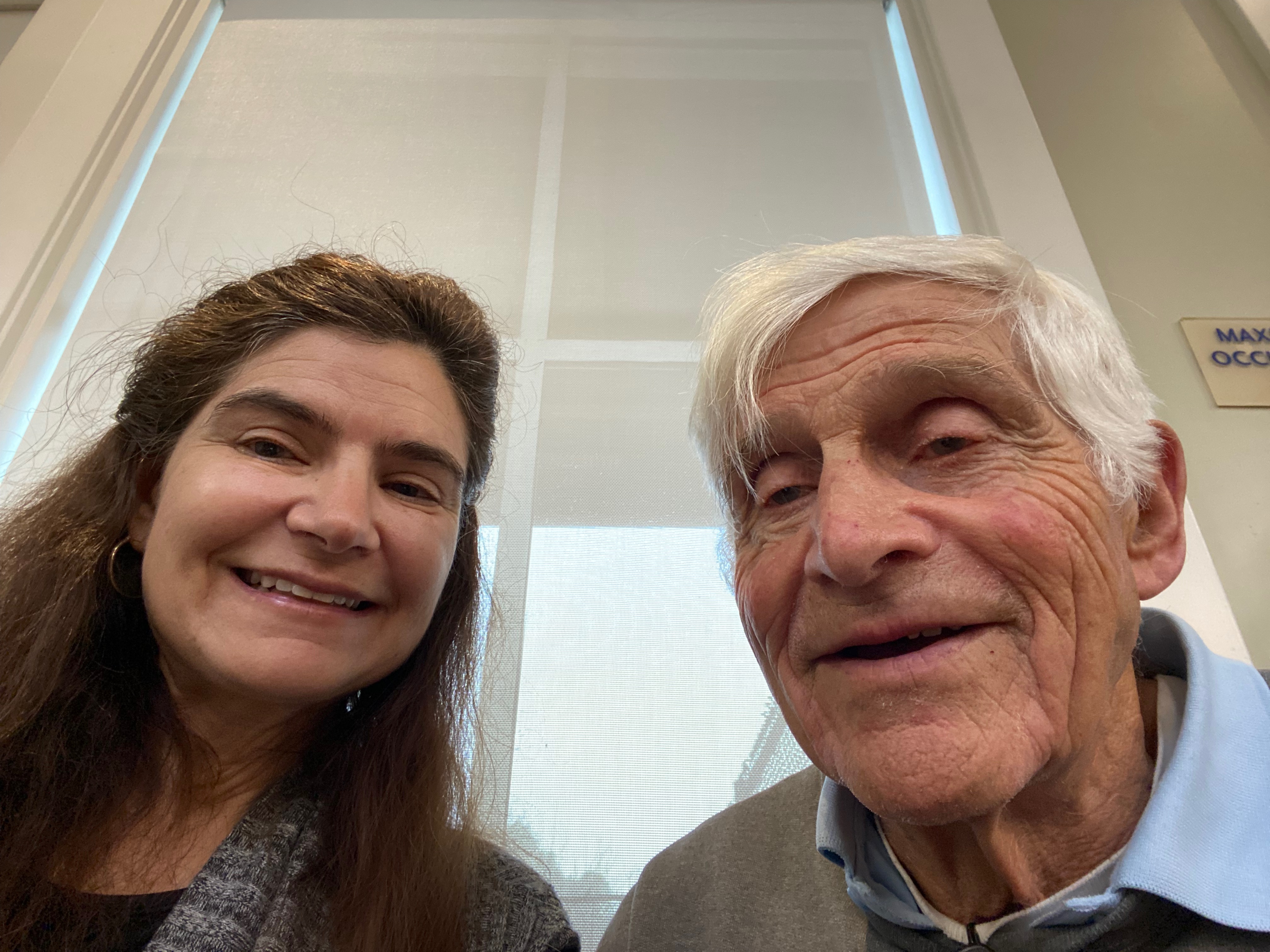
I stay late at the party, huddling under the heat lamp warming our corner of the booth. Mr. Landau recounts some of his victories as a member of the school board and Rotary club, back when Camille and I were girls. He tells me these days his life is focused on helping his 87-year-old brother, his only sibling, who lives in New York and is about to have hip surgery. He has been flying back and forth all year and has another trip there next week. I’m surprised that George, not exactly young himself, is flying back and forth to New York to help his brother. I remember the line from the movie: “George, you were always of great help and comfort to us.”

We face so many choices each day, some small and some large. Something within me has made a choice to walk with others in their spiritual lives. I want to be a witness to their hills and valleys, darkness and light. And I want to pass along those things my parents and grandparents taught me—the informal prayers and the formal ones—in all their complexity and nuance. Is it true, what the psalmist says, “Yea, when I walk through the valley of darkness, I will fear no evil”? I can’t quite say I have no fear. But will goodness and mercy follow me all the days of my life? Yes, I believe that wholeheartedly.


What happened when I quit social media for Lent

What happened when I quit social media for Lent


I’ve never been one to celebrate Lent. I don’t like the idea of having to give up something. I’ve always thought I would fail anyway. Then I’d feel bad. This year, however, I decided to embrace Lent. I felt like a needed a refresh of my life after my divorce and all the changes that came with it. I wanted to change some habits and live a more spiritually balanced life. I guess I could have given up chocolate or coffee, but I wanted something deeper.

The fact is, Lent gave me an excuse for an experiment I’ve wanted to try for a while…what would happen if I stayed off of social media for an extended period of time? Would I use that “wasted” time to do more productive things? Would I read more? Write more? Pray more? Be more at peace? What would happen?

As I write this I’m wrapping up my experiment. It’s now Easter morning. Lent is officially over and the results have been interesting. It’s been about 40 days since I’ve spent any time on Facebook or Instagram. I’ve gone from spending several hours a day on those platforms to zero. The only exception I made was to check and respond to DMs. Otherwise I resisted the pull of FB and Insta.

This yearning to control my social media addiction has been growing for a while. It was easy to see things were out of hand. Social media was the last thing I did at night and the first thing I did in the morning. From talking to friends, I know my habits aren’t unusual. I also used it during the day when I felt bored, lazy or just wanted some hits of dopamine that scrolling can provide. Often I would pick up a book to read but put it back down to scroll instead. With my divorce, my habit grew as I suddenly was alone a lot. Social media became my companion, even at the dinner table. Fork in one hand, phone in the other.

I felt especially bad about my social media habit because of my role as a spiritual director, in which I accompany people in their spiritual journey. How could a so-called spiritual leader spend so much time on social media? It didn’t seem right.

So what happened during my 40 days? First off, I experienced a surprise. I thought it would be hard to break the habit. I thought I’d have some kind of withdrawal. But it wasn’t that difficult. I picked up my phone often and was tempted to press the big F icon on my phone screen, but I caught myself. What did I do instead? I usually couldn’t just put my phone down, so I clicked on the New York Times icon and read the headlines and an article or two. It was relatively easy. I found I still got a dopamine hit from scrolling headlines. And then I could move onto other things.

What were the “other things”? I began to take my dog out for walks more often. I tidied the house more. I dug into my pile of clothes to be ironed. I journaled a few lines before I went to sleep. I read books more often, though not as often I as I thought I would, even though I put my Kindle app on the home page of my phone. Books just don’t deliver the instant dopamine hit of other activities.

I won’t lie though. I really missed seeing posts from my friends. I missed scrolling through all the Insta miniature schnauzer accounts before bed (I have a miniature schnauzer). I missed learning about cultural events or news on FB. I had a big case of FOMO.

I was constantly tempted to press the FB or Insta icons. Then, someone suggested I move those icons off the home page of my phone and bury them on the fourth or fifth page. I did that and it helped. My FOMO decreased.

I wondered in the midst of all this whether anyone noticed I was gone. My guess is no. Everyone is so caught up in their own worlds. They probably didn’t give my absence a thought. That felt a bit sad. Sad, but true.

I’ve had a love-hate relationship with social media for a long time. Social media isn’t all bad. It lets you reconnect with old friends, connect more with new friends and learn about all kinds of things. I post my blogs on Facebook and I’d say it’s the number one way people find out I’ve written a new blog post. Facebook has enabled me to get my writing out to more people.

Now that it’s Easter, I’m a little relieved my experiment is over. I can go back to FB and Insta, but maybe in a more moderate way. My son told me there’s an app that restricts your use of social media to a time you set. I will need that.

That said, part of me does wonder whether I should just quit the habit cold turkey. I feel like social media has decreased my attention span. I have more trouble reading books than I used to. I attribute that in large part to the way social media delivers dopamine hits one after another. A book doesn’t do that. It’s satisfying but it demands a kind of longer-term attention that pays off in a bigger, maybe more delayed reward.

Even if I quit social media, I’d still have my phone, which has plently of other tempting distractions: texts, emails, news sites, Nextdoor, etc. Writer Hugh McGuire writes about his attachment to his phone this way: “Spending time with friends, or family, I often feel a soul-deep throb coming from that perfectly engineered wafer of stainless steel and glass and rare earth metals in my pocket. Touch me. Look at me. You might find something marvellous.” I can relate.

The other day a friend came over for breakfast. She talked about her decision to stop wearing her smart watch. I’ve been wearing a smart watch for about a year now. The thought was intriguing to me. My watch is constantly beeping at me, telling me to stand up and move or buzzing me with a headline or text. I know there’s probably a way to turn those things off…but maybe I could do without it entirely.

This morning when I got ready for church (and after writing this) I decided to wear a regular watch instead of my smart watch. I felt much calmer, less distracted. Only time will tell if my experiments have lasting results. Check back with me in a month and I’ll let you know. For now, I’m excited that I can check out FB and IG again today. I look forward to seeing what people are doing on Easter. See you there!


Snapshots from Spain

Snapshots from Spain


I had great hopes for keeping up my blog while on my trip. Somehow, though, our hosts and friends kept us busy and the 10:30 pm dinners didn’t leave time for writing at the end of the day! Instead of trying to recall details, which are already becoming fuzzy in my mind, I thought I’d give a few memorable snapshots of our time.

Snapshot 1: After a few days in Madrid, we pack our bags for Fuerteventura, one of the islands that make up the Canary Islands. The islands are off the coast of Africa and a two-and-a-half hour plane ride away from Madrid. We have been told by Sebastian and Monica to rent a car, but not make hotel arrangements. I assumed we’d be staying at their house there. As we leave they tell us to go to the Costa Calma Palace hotel. We don’t know what to expect. Sebastian tells us that it will be very dark on our drive there from the airport. Just take your time, he says. Look at the stars. Fuerteventura is an ideal place to see the stars, with little light pollution. We land and rent our car and find a very large luxury hotel. We are shown to three very nice rooms, each with a bucket of ice and champagne bottle and a basket of fruit. We all have ocean views. Amazing! We assume that Monica knows the owners of this hotel and has made a trade of some sort to acquire these rooms for us. As it turns out, the next day she tells me she is the owner! We are given the deluxe package, which includes three meals a day. The breakfast buffet alone is impressive. I’ve never seen a buffet so large. We decide we don’t need to see anything more than this on the island!

Snapshot 2: Miguel’s girlfriend, Naava, arrives on our second day in Fuerteventura. She also can’t believe our plush accommodations. I met Naava once over Christmas last year, but it was brief. It will be nice to get to know her better on this trip. As soon as we’ve had our massive breakfast buffet, Monica and Sebastian meet us at the hotel and tell us to follow them. We are going to see a pretty beach. Indeed, the beach is nice, with white sand and relatively few people. The water is warm enough to swim in and refreshing—unlike the Pacific. Now, though, we are going to see a second beach. To get to this beach we have to drive over a rough, unpaved road. When we get back, Miguel notices that the air in one of the tires is low. We decide something has punctured it and it has a slow leak. Oh no! Had I bought the right insurance? What if they charge us for a new tire? We spend the rest of the trip constantly filling the tire with air and I tell the rental car people about the problem when we drop it off. “No pasa nada,” they say, “we will check it.” Phew!

Snapshot 3: We ate lots of good food in Fuerteventura. One unique thing they have is a tray of three dipping sauces they always bring out with the bread before the meal. There’s a red tomato-based sauce, a white garlic sauce and a green cilantro-based sauce. We all agree the green sauce is the best. We eat a lot of fish there, typically a whole fish that is fried, with the head still on.

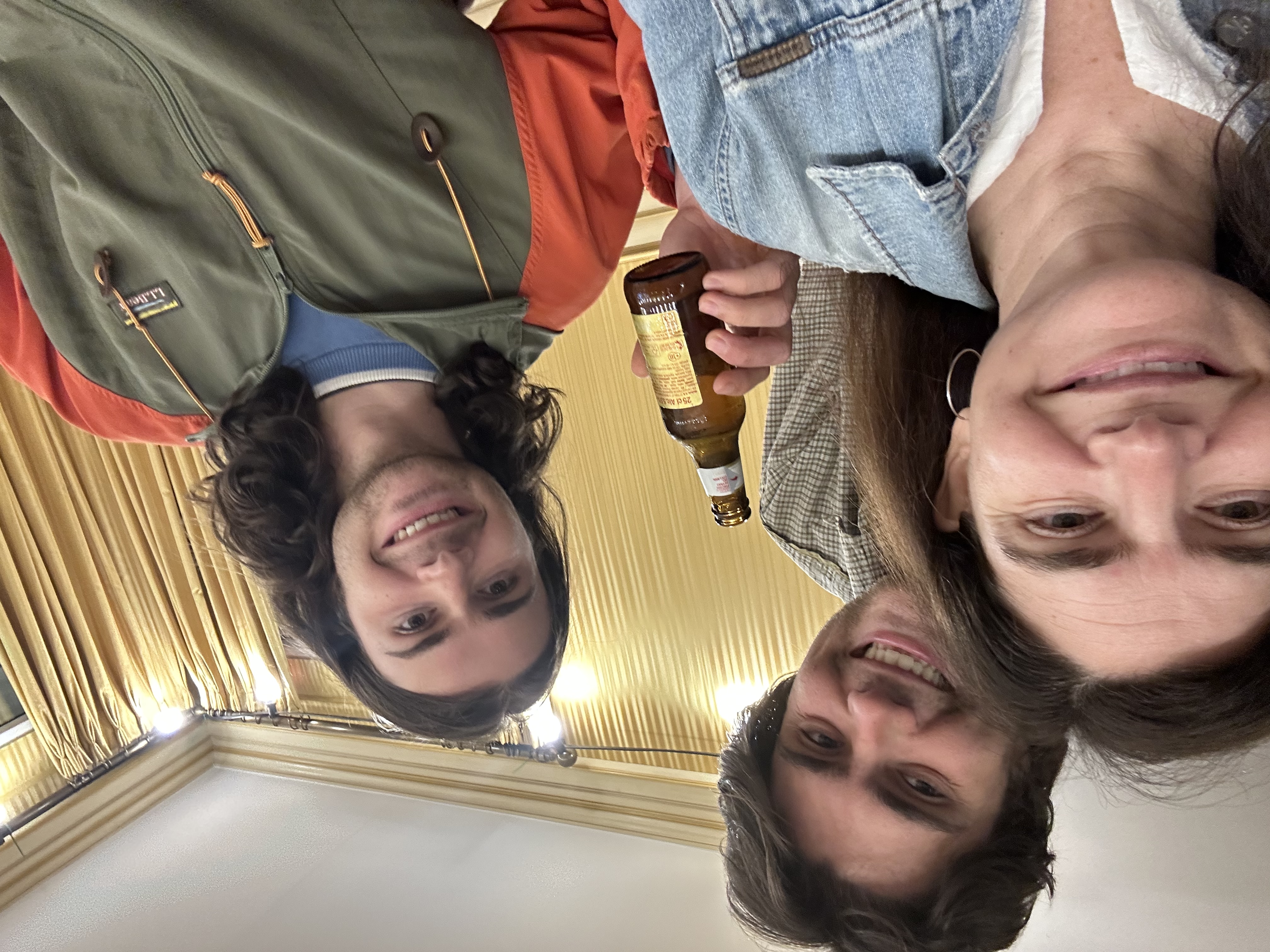
Snapshot 4: When Miguel, Naava and I leave Spain, Thomas plans to walk the Camino, an ancient pilgrimage route across Northwest Spain. He has packed very lightly for this trip, knowing he will have to carry everything on the Camino, doing 10 to 15 miles a day. He’s had long hair for the past several years but decides to cut it in case it’s hot on the Camino. It’s a significant day when he goes to the salon and cuts his curly locks. He looks great though and feels a lot lighter.

Snapshot 5: Thomas still needs a few more items for the Camino so he and I go shopping in Madrid. We mostly strike out. We go to the big sports store, Decathlon, but they are sold out of waterproof covers for backpacks. (Thomas later gets one from the “chino”—the Chinese bazaar that sells odds and ends.) We also go to the church where supposedly they hand out the official Camino cards, which are like passports you get stamped at each stop along the route. (He can get one later.) Then we go to Desigual, my favorite clothing store, known for their bright colors and modern designs. Thomas finds a great sweater for me and I find a nice shirt I’ll give to Peter for taking care of Romeo. As it gets later in Madrid, the streets fill up. Everyone is out taking a paseo or dining. It looks like Covid never existed. We end our outing with some tapas, including croquettas and patatas with aioli.

Snapshot 6: Time for a cafecito? It seems it’s always time for a coffee with Sebastian. He is a gracious host and has bought a jamon leg for us and stocked the fridge with yogurt, snacks and fruit. He has also picked us up and driven us to the airport. I really hope I can get the painting we left at SFO back and shipped to him. In the meantime, upon learning that Naava and Miguel are painters, he has purchased two canvases and oil paints for them. They spend their last day in Madrid painting the ocean. Naava paints from a photo of Fuerteventura and Miguel paints from a photo of a California beach. The paintings turn out beautifully.

Snapshot 7: We enjoy a typical Spanish dinner of tortilla and gazpacho soup with our home exchange family in their new house. They spend much of the night reminiscing about their time in Berkeley and their fond memories of our neighborhood and school. We laugh a lot and switch between Spanish and English. We enjoy other similar reunions with Paloma and her children and Angeles and her boys. Angeles kindly lends Thomas a hiking stick and sleeping bag for his Camino hike.

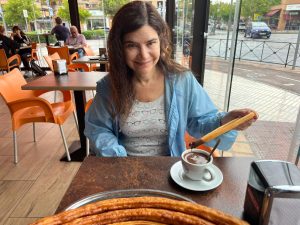
Snapshot 8: On my last day in Madrid, Sebastian has decided we will make chili. I served him chili when he and Monica came to dinner in California and he loved it. So we head to El Corte Ingles and buy the ingredients…all except for the chili powder, which they don’t carry in Spain. The closest we can get is Mexican tajin spice, which has chili powder in it, along with lime and salt. In the end, we make a pretty good chili. Monica doesn’t want any though. She’s afraid it will be too spicy. Spanish food isn’t very spicy. Also on my last day, I finally get to have churros y chocolate! Thanks Sebastian for taking me to your favorite spot.

There is so much of Spain still to see; I look forward to going back and seeing more of the Canary Islands. In addition to Fuerteventura there are seven other Canary Islands, each with its own feel, just like Hawaii. Fuerteventura is dry and arid. They get their water from a desalinization plant. Some of the other islands, like Gran Canaria have sections that are green and lush. Hasta la proxima España! See you next time.

The llegada (arrival) in Madrid!

The llegada (arrival) in Madrid!


Our Spanish adventure 2023 has begun! It’s amazing to think I haven’t been here in 8 years, since 2015. Before that it was 2010-2011, the year we lived in Madrid and did our house exchange. After doing the house exchange I had grand plans to come back every year, but life and other travels got in the way. 

This trip started with a few snafus, as trips often do. Our plane from San Francisco to London was delayed and the check-in agent told us that all the connecting flights from London to Madrid were sold out (even though we had a ticket for a connecting flight). The end result—we would have to wait 12 hours overnight in London for a connecting flight with space.

In the disappointment of the moment, we walked away from the ticket counter without one item—the special gift we intended to give our Spanish hosts, Monica and Sebastian. The gift was a beautiful oil painting of a vineyard in California. It was the perfect gift because Sebastian sells wine and lived in California six years. In fact, we met Sebastian at a wine tasting event at the Berkeley Country Club and instantly became friends, thanks to his outgoing personality and our love of all things Spanish. In any case, we left the painting behind and only remembered it when we were about to board our flight. Fortunately, we had time to call the operator on an airport phone and find out how to file a lost and found report. It seemed like a long shot that we’d get the painting back. 

During our wait for the plane, travel-savvy Miguel found a snug little AirBnB 10 minutes from Heathrow. I had wanted to stay at a hotel even closer to the airport and take a train to the city center to ride the Eye, but Miguel probably made the right choice. “This way we can see a real neighborhood,” Miguel said.

It’s a 10-hour flight from San Francisco to London. We slept a good part of it but not enough. When we checked into our AirBnB, our host said we looked a little “knackered.” And just like that a new word has entered our vocabulary! We asked our host where good Indian food would be and he gave us a few suggestions. We tried a place that was part pub, part Indian restaurant. In addition to the usual dishes of tikka masala, lamb curry, and samosas, we had an tasty naan with nuts and raisins inside. Then it was back to the AirBnB to sleep for a few hours before returning to the airport. 

Our next flight, to Madrid, felt quick compared to our last flight. Best of all, Sebastian had come to the airport to pick us up. He is the kind of person that radiates enthusiasm. He had never met my boys before as they had been away at school. He connected with them instantly.

Sebastian and Monica grew up in the Canary Islands and have a house there. Sebastian became a pilot and Monica worked for her family business in the travel industry. They had two sons (now 12 and 15) and 7 years ago they made a major life change. Sebastian hung up his pilot’s hat, tired of being away from his family so often and he and Monica (who could work remotely) decided to come to California so their boys could learn English. They stayed in California 6 years and just a year ago returned to Spain so their boys could attend high school in Spain. They decided to live in Madrid because they felt the boys would get a better education there than in the Canaries. 

Last year, as Sebastian and Monica were preparing to leave California, they told us they had purchased a large house in Madrid and we were welcome to come visit any time. Specifically, they said the house had seven bedrooms and eight bathrooms. We were all curious to see the house. Upon our arrival, we had a grand tour. It is a large house, for sure, but it doesn’t feel flashy. OK, maybe the living room, which is the size of my living room, kitchen and dining room and more, is a little over the top. And maybe the basement floor, which has a wine cellar, swimming pool, movie room, and exercise room is rather luxurious. Then there is the elevator. You really never need to leave home. TJ, Miguel and I all got our own rooms, with our own bathrooms. 

After settling in, Sebastian unveiled his new jamon leg and gave us fresh slices. It was just as delicious as we remembered—buttery and chewy at the same time. Then we had a delicious beef stew that Sebastian made (he’s the cook in the house). It would be very difficult to be a vegetarian in Spain. Later that evening we called an Uber to have dinner with a family we had gotten to know through the boys’ school when we lived here in 2010-2011. It was Miguel who first made the connection with the Lopez family. Early on Miguel was struggling with communication in Spanish and his home room teacher specifically assigned Gonzalo Lopez to be Miguel’s buddy and help him along. Through Gonzalo, we meet his sister, brother and parents. They are all lovely people. The kids really hadn’t changed. Only now instead of talking about what score they got on the “ciencias naturales” and matematica exam, they were talking about jobs and how to find the best one. We were definitely knackered after that dinner! It was time to sleep. 

The focus of our second day in Madrid was sleeping (still catching up with jet lag) and getting ready for a big party. Sebastian set up his giant paella pan on a huge portable burner  connected to a butane canister. We watched as his sister diced up garlic, onions, peppers, tomatoes, squid and many more ingredients, which his brother-in-law added to the pan. The aroma was amazing. 

The food was taken care of, but what about the seating? Where do you put 25+ people? Monica has been so busy with her work opening a new hotel in Vietnam this year that she hasn’t had time to buy furniture for the dining room or living room. They solved this dilemma by buying several folding tables and 25+ folding chairs. In the end it was a grand feast. Someone brought a guitar and sang after dinner and there was a bit of dancing. I went to bed around 12 but my boys stayed up until 2 talking to the other young people. 

Back to the painting..I got an e-mail as we were taking off for London that they had “likely” found our painting (it’s all wrapped up in paper) and will hold it for nine weeks. Yay! Sadly though, the cost of mailing might be so high it doesn’t make sense to send it. We’ll have to find another way to thank our generous friends. In the meantime, we did bring two bags of chocolate chips for the family to make cookies with. We learned back in 2010 that stores here don’t carry chocolate chips. Who doesn’t like chocolate chip cookies?